
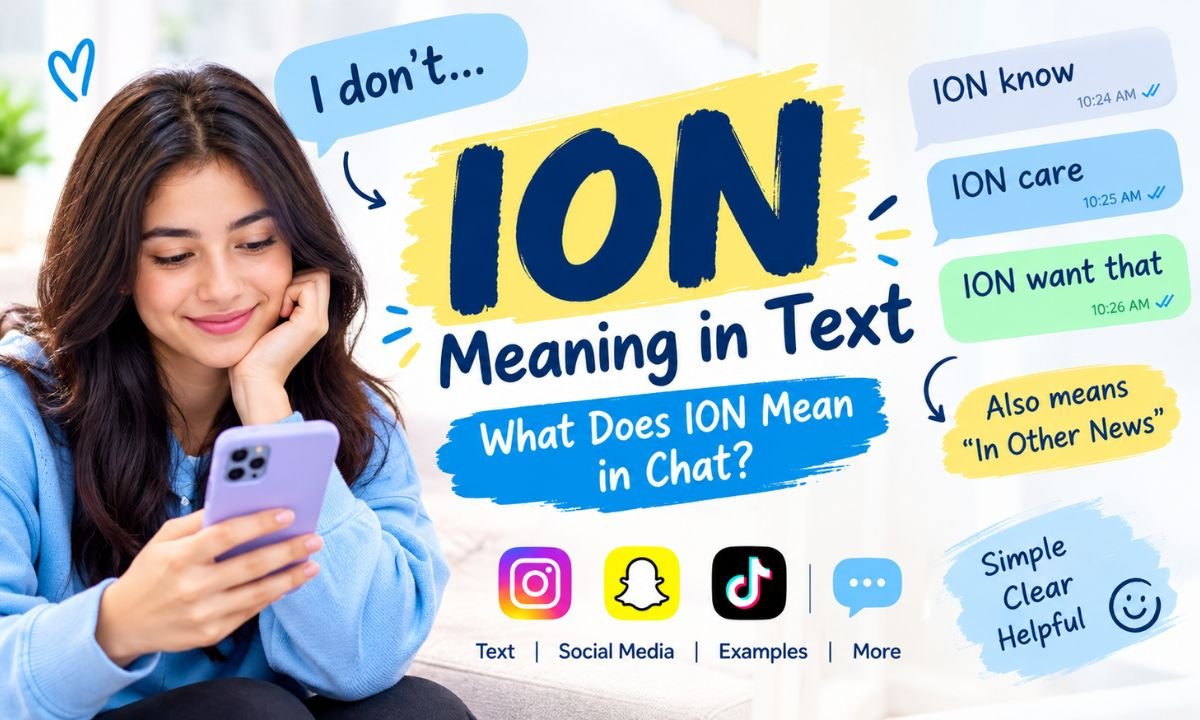

If you’ve seen “ion” pop up in a text or comment and paused mid-scroll, you’re not alone. In casual texting, ion usually means “I don’t.” It’s a squished, fast-typed version of “I don’t,” and once you know that, most sentences using it suddenly make sense.
But like a lot of internet slang, ION isn’t always that simple. The exact meaning can shift depending on where it shows up in a sentence, who’s texting it, and what platform you’re on. This guide breaks down every common meaning of ION, shows you real examples, and helps you reply like you’ve been using it for years.
What Does ION Mean in Text?
ION Usually Means “I Don’t”
In most everyday texting, ION is shorthand for “I don’t.” It’s typically followed by a verb, just like the phrase it replaces:
- “ion know” = I don’t know
- “ion care” = I don’t care
- “ion want to go” = I don’t want to go
Think of ION as a contraction that skipped a few steps. Instead of typing out three separate words, texters mash the sounds together into one quick block of letters.
Why “I Don’t” Becomes “ION”
The shift from “I don’t” to “ion” comes from how the phrase actually sounds when spoken quickly and casually. Say “I don’t” fast, and the “d” and “t” sounds often soften or disappear entirely, leaving something closer to “ion.”
Texting slang frequently mirrors spoken speech patterns rather than formal spelling, and ION is a clear example of that. This pronunciation-based spelling has roots in African American Vernacular English (AAVE), which has shaped a huge share of modern internet and texting slang.
Is ION an Abbreviation or Slang?
ION isn’t a traditional abbreviation like “ASAP” or “FYI,” where each letter stands for a separate word. Instead, it’s a phonetic slang term it’s spelled the way it sounds, not the way the original phrase is spelled. That puts it in the same category as words like “finna” (fixing to) or “tryna” (trying to).
What Does ION Mean in Chat?
ION in Casual Text Messages
In group chats, DMs, and texts between friends, ION almost always keeps its “I don’t” meaning. It’s informal, quick, and works best in low-stakes, relaxed conversations.
ION at the Beginning of a Sentence
When ION opens a message, it’s usually setting up a personal opinion or reaction:
“ion think that’s a good idea” “ion really care what they said”
Starting a sentence with ION signals that a personal stance or feeling is coming next.
How Context Changes the Meaning of ION
Context is everything with ION. The word right after it usually tells you exactly what’s meant:
- Followed by “know” → uncertainty
- Followed by “care” → indifference
- Followed by “like” → dislike or disapproval
If ION appears completely on its own, without a verb attached, it’s worth double-checking the context it could be referencing something other than “I don’t” (more on that below).
ION Meaning With Common Text Examples
“ION Know” Meaning
“ion know” means “I don’t know.” It’s used exactly like the standard phrase, often as a quick response to a question you’re unsure about.
“ION Care” Meaning
“ion care” means “I don’t care.” It signals indifference, and depending on tone, it can come across as relaxed or a little blunt.
“ION Want” Meaning
“ion want” means “I don’t want.” It’s typically followed by whatever is being declined: “ion want no drama.”
“ION Think So” Meaning
“ion think so” means “I don’t think so.” It’s a soft way of disagreeing or expressing doubt about something someone said.
“ION Like That” Meaning
“ion like that” means “I don’t like that.” It expresses disapproval, and depending on the situation, it can range from mild to more serious pushback.
ION Meaning on Social Media
ION on Instagram
On Instagram, ION shows up most often in comments and captions, keeping its “I don’t” meaning for example, “ion post enough fr.” It’s also sometimes used stylistically in captions related to mood or energy, closer to “vibe” than “I don’t.”
ION on Snapchat
On Snapchat, ION is used the same casual way it’s used in regular texts, especially in quick chat replies and Snap captions where speed matters more than spelling.
ION on TikTok
On TikTok, ION appears frequently in comment sections, often paired with strong opinions: “ion get the hype tbh.” It’s also common in trending audio captions expressing a personal take.
ION Meaning in Social Media Comments
In comment threads across platforms, ION is almost always the “I don’t” version. Comments are quick, informal, and reactive exactly the environment where ION thrives.
How to Understand ION From Context
ION Before a Verb
When ION is directly followed by a verb (know, care, like, want, think), it’s safe to read it as “I don’t” plus that verb.
ION in a Short Reply
If someone replies to a question with just “ion,” they’re likely saying “I don’t know” it’s an even shorter, trimmed-down version used in fast back-and-forth chats.
When ION Does Not Mean “I Don’t”
ION doesn’t mean “I don’t” when it’s:
- Used as an abbreviation for “In Other News” to switch topics
- Referring to the chemistry term (a charged atom or molecule)
- Part of a username, hashtag, or brand name
Does ION Have Other Meanings?
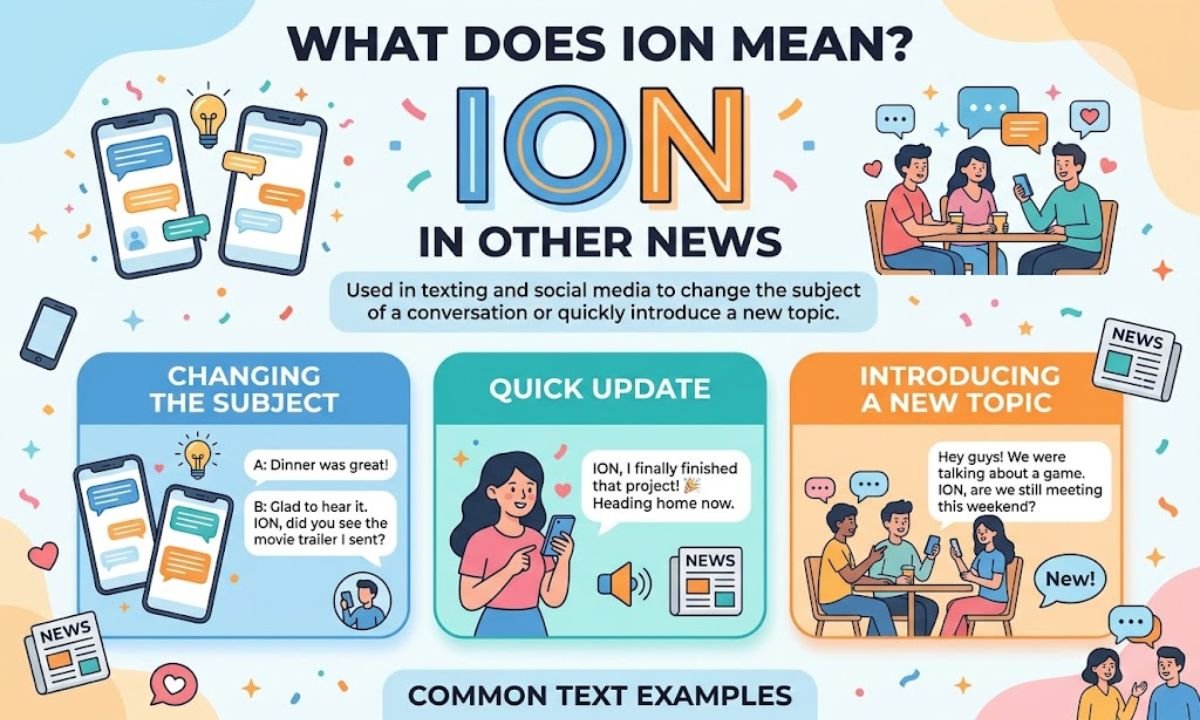
ION Meaning “In Other News”
Some texters use ION as shorthand for “In Other News,” usually to pivot the conversation to a new topic: “ion, did you hear about the party?” This usage is less common than “I don’t” but does appear, especially in group chats and social posts.
ION as a Chemistry Term
Outside of slang, “ion” is a real scientific term referring to an atom or molecule with an electric charge, caused by gaining or losing electrons. This meaning shows up in science classes, textbooks, and technical writing not casual texting.
How to Tell Which ION Meaning Someone Intended
| Signal | Likely Meaning |
| Followed by a verb (know, care, like) | “I don’t” |
| Used to change topics mid-message | “In Other News” |
| Appears in a science or chemistry context | Charged particle |
| All lowercase in casual chat | Slang “I don’t” |
What Tone Does ION Have in Texting?
Is ION Casual or Formal?
ION is strictly casual. It belongs in texts, DMs, and social media comments not emails, resumes, or professional messages.
Can ION Sound Rude?
ION can come across as blunt or dismissive, especially in phrases like “ion care,” depending on tone, punctuation, and the relationship between texters. Among close friends, it usually reads as normal and harmless.
Can ION Show Attitude or Emphasis?
Yes. Stretching it out (“ionnnn care”) or pairing it with caps can add emphasis, sarcasm, or extra attitude to a message.
How Do You Reply When Someone Says ION?
Simple Replies to “ION Know”
- “That’s fair, let’s figure it out.”
- “No worries, we’ll ask someone else.”
How to Respond to “ION Care”
- “All good, I’ll decide then.”
- “Okay, just checking.”
Friendly Replies to ION in a Chat
- “Lol fair enough.”
- “Same tbh.”
When Should You Use ION?
Using ION With Friends
ION works well in relaxed, familiar conversations where texting shorthand is already common.
ION in Social Media Messages
It fits naturally in comments, captions, and DMs where a quick, informal tone is expected.
When to Avoid ION in Formal Writing
Skip ION in emails, cover letters, school assignments, or workplace messages. Stick to “I don’t” in any setting where professionalism matters.
ION vs “I Don’t”: What Is the Difference?
ION in Casual Conversations
ION is faster to type and feels more relaxed, making it a natural fit for texting and social media.
“I Don’t” in Standard English
“I don’t” is grammatically correct and appropriate for any setting, from casual chats to formal writing.
Which One Should You Use?
Use ION with friends and on social platforms. Use “I don’t” for anything formal, professional, or written for a general audience.
ION Meaning in Text: Quick Examples
| ION Phrase | Standard English |
| ion know | I don’t know |
| ion care | I don’t care |
| ion want that | I don’t want that |
| ion like it | I don’t like it |
| ion think so | I don’t think so |
| ion remember | I don’t remember |
Frequently Asked Questions
What does ION mean in texting?
ION typically means “I don’t,” used as a quick, phonetic shorthand in casual messages.
What does ION stand for in chat?
It doesn’t stand for separate words like a true acronym it’s a spelled-out sound representing “I don’t.”
Does ION mean “I don’t”?
Yes, in the vast majority of texting contexts, ION means “I don’t.”
What does ION mean on Snapchat?
On Snapchat, ION is used the same way as in texts, almost always meaning “I don’t.”
What does ION mean on TikTok?
On TikTok, ION usually means “I don’t,” often used in comments to share an opinion.
Is ION slang?
Yes, ION is internet and texting slang rooted in casual, spoken-style spelling.
Is ION formal English?
No, ION is informal and should be avoided in professional or academic writing.
Can ION mean “In Other News”?
Occasionally yes some texters use ION to mean “In Other News” when switching topics, though this is far less common than “I don’t.”
Conclusion
ION is a small word doing a lot of work in modern texting. Most of the time, it simply means “I don’t,” but paying attention to the word right after it and the platform you’re on will help you catch the rare exceptions, like “In Other News” or the actual chemistry term. Once you get the hang of it, ION becomes just another quick, natural piece of how people text today.
