


Seen “WTV” pop up in a chat and not sure how to take it? You are not alone, because this tiny abbreviation can sound relaxed, bored, or annoyed. The answer depends on who sent it and how.
WTV is short for “whatever.” It is one of the most common texting abbreviations on WhatsApp, Snapchat, Instagram, and TikTok. People use it to show flexibility, indifference, or a quick end to a topic.
In this guide, you will learn the exact WTV meaning in text, where it came from, and how to read its tone. You will also find real examples, smart replies, and a clear list of when to avoid it.
WTV Meaning in Text: A Quick Explanation
WTV means “whatever.” It is a casual shorthand used in text messages, chats, and comments to say “I don’t mind,” “it’s fine,” or “I don’t care.”
The word itself is neutral. The feeling behind it is what changes. A friendly “wtv works 😊” and a cold “wtv.” can mean two very different things.
What Does WTV Mean in Simple Terms?
In simple terms, WTV is a digital shrug. 🤷 It tells the other person that you are okay with any option, or that you are done discussing the topic.
| Tone | What it signals | Example |
| Easygoing | You are flexible | “Pizza or tacos? wtv is fine 😄” |
| Indifferent | You have no strong opinion | “wtv, you pick” |
| Annoyed | You want to stop talking | “wtv.” |
| Playful | You are teasing | “wtv lol you’re so dramatic” |
The Origin and Background of WTV Slang
WTV comes from the English word “whatever,” with the vowels dropped to save typing time. This is a classic texting habit, the same one that gave us “pls,” “thx,” and “tmrw.”
Short codes grew popular in the early days of mobile texting, when messages were limited by character counts and typing on number keypads was slow. Even though phones are faster now, the habit stayed. Shorter replies also feel casual and quick.
“Whatever” itself has long been used in spoken English to show indifference. Teen slang in the 1990s turned it into a dismissive catchphrase. When chat culture moved online, WTV simply became the typed version of that same attitude.
Today, WTV lives mostly in private chats and social media comments. Dictionaries and slang guides list it as a standard informal abbreviation for “whatever.”
Its popularity also comes from speed. Typing three letters takes less than a second, and that suits fast group chats where nobody wants to write long replies. Over time, the shortcut became part of everyday online language, much like “brb” or “omg.”
WTV in Real-Life Conversations: Common Examples
The same three letters can feel different on every app. Here is how people usually use WTV on popular platforms.
WTV in WhatsApp Chats: A Casual and Relaxed Tone
On WhatsApp, WTV is mostly used for quick planning between friends and family. It shows you are flexible and not picky.
- Friend 1: “Where should we eat tonight?”
- Friend 2: “wtv you guys want 👍”
Here it is warm and cooperative. Adding an emoji almost always keeps the tone light.
WTV on Snapchat: A Casual Way to Get to Know Someone
On Snapchat, people use WTV in fast, playful replies. It often keeps a new conversation relaxed.
- Snap: “What are you up to this weekend?”
- Reply: “wtv, probably just chilling 😎 you?”
It works as a low-pressure answer that invites the other person to share more.
WTV in Instagram DMs: Expressing Mild Annoyance
In Instagram DMs, a short “wtv” after a disagreement often signals mild annoyance. The lack of emojis and the full stop make it feel flat.
- Message: “You never replied to my story!”
- Reply: “wtv.”
If you see this, the sender may be tired of the topic or feeling a little hurt.
WTV in TikTok Comments: A Playful or Casual Tone
On TikTok, WTV usually shows up as a joke or a lighthearted comment under a video.
- “People argue about pineapple pizza forever, wtv I love it 🍕”
- “wtv, I’m still watching this on repeat 😂”
Here it reads as playful confidence, not anger.
The Emotional and Psychological Meaning of WTV
Because text has no voice or face, readers fill in the emotion themselves. That is why WTV can feel bigger than three letters.
People usually use WTV for one of these reasons:
- To avoid conflict. Saying “wtv” feels easier than arguing.
- To show trust. You let the other person decide.
- To hide hurt. Some people act uninterested when they actually care.
- To save energy. After a long day, a short reply feels simpler.
Psychologists often describe the dismissive use as a form of emotional withdrawal. The sender steps back from the conversation instead of sharing how they feel. That does not always mean anger, but it can be a sign worth noticing. 💭
Quick tip: If a “wtv” feels off, read the previous messages. The mood of the chat usually tells you the real meaning.
Example: Imagine you tell a friend you are nervous about an exam and they reply, “wtv, you’ll be fine.” That could be a clumsy attempt at comfort. If they reply “wtv.” after you share the same worry, it feels cold. The words are almost identical, but the intent is not, so always weigh the context.
How WTV Is Used in Different Contexts
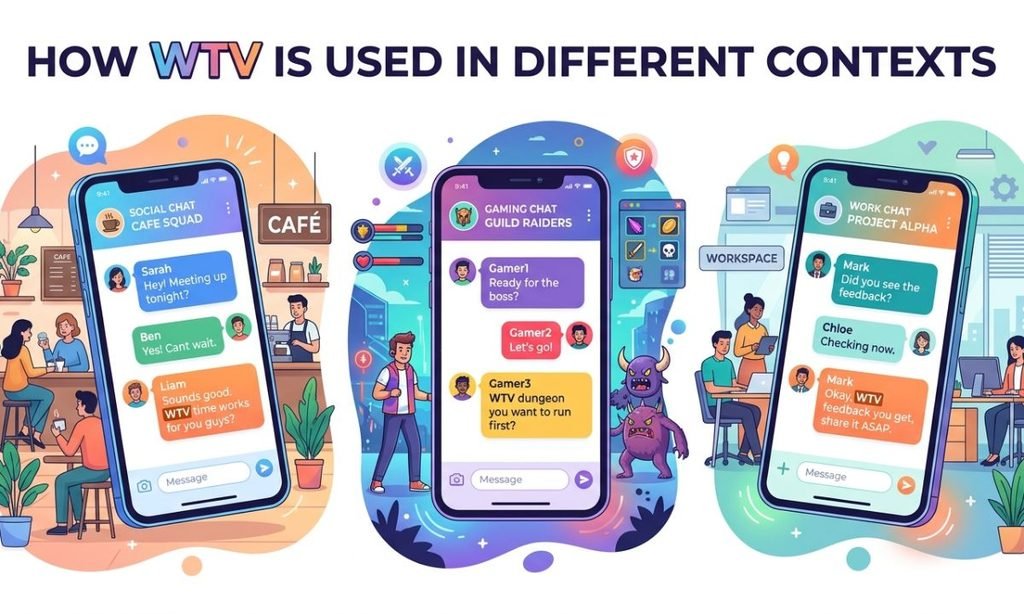
Context decides everything. The same abbreviation can be friendly in one chat and rude in another.
WTV on Social Media Platforms
On public platforms, WTV is common in comments, captions, and stories. It often adds attitude or humor, such as “wtv, I’m doing my own thing ✨.” Because many people read it, creators tend to use it in a confident or funny way.
WTV Among Friends and in Relationships
Among close friends, WTV is usually harmless. It shows you are easygoing.
In a relationship, however, it can sting. If your partner shares a worry and you answer “wtv,” it may feel like you do not care. Many couples treat repeated one-word replies as a warning sign of poor communication.
Better alternatives in relationships:
- “I’m happy with either one 😊”
- “You choose, I trust you.”
- “I’m too tired to decide, can we talk later?”
Is WTV Appropriate in Professional Settings?
No. WTV is not appropriate for work emails, client chats, or messages to teachers and managers. It can sound dismissive or lazy.
Instead of “wtv,” try:
- “Either option works for me.”
- “I’m flexible, so please choose what suits the team.”
- “No preference from my side. Thank you.”
Understanding WTV in Casual vs. Serious Conversations
| Situation | Is WTV okay? | Why |
| Picking a movie with friends | ✅ Yes | Low stakes |
| Joking in a group chat | ✅ Yes | Playful tone |
| Talking about a problem | ⚠️ Risky | Sounds dismissive |
| Apologizing or resolving a fight | ❌ No | Feels like you don’t care |
| Work or school messages | ❌ No | Too informal |
WTV Meaning from a Girl or a Boy
There is no official difference between how girls and boys use WTV. The meaning depends on the person, not gender.
Still, people often read it differently:
- From a girl: It may be playful, or it may signal she is upset and does not want to explain. Check her usual texting style.
- From a boy: It often means he has no strong preference or wants to move on. Short replies are common for many guys, so it is not always negative.
The best approach is to look at past behavior. If someone normally texts with emojis and suddenly sends a cold “wtv.”, something may be wrong. If they always text briefly, it is probably just their style. 👀
Example: If your best friend usually writes long, bubbly messages and suddenly sends “wtv.”, it is worth a gentle check-in. But if a classmate who only sends one-word texts says “wtv,” that is simply how they talk. Pattern matters more than gender.
Common Misinterpretations of WTV
People misread WTV all the time. Here are the biggest mix-ups:
- Thinking it always means anger. Many people use it in a relaxed way.
- Assuming it means “I don’t love you.” It rarely has anything to do with feelings for you.
- Reading too much into punctuation. A full stop can change the tone, but not always.
- Confusing it with a TV-related term. A few usernames or channels use “WTV,” but in chats it nearly always means “whatever.”
When in doubt, ask. A simple “Are you okay with that?” clears up confusion fast.
Another common mistake is replying with sarcasm. A reply like “Wow, nice attitude” can turn a small moment into a big argument. Stay calm, assume good intent first, and ask a simple question before judging the message. 💬
Situations Where You Should Avoid Using WTV
Skip WTV in these moments:
- When someone shares bad news or feelings
- During an argument you want to solve
- In work, school, or business messages
- When replying to elders or someone you just met
- When the other person asks a serious question
In these cases, a clear sentence shows respect and care.
WTV vs. Similar Texting Abbreviations
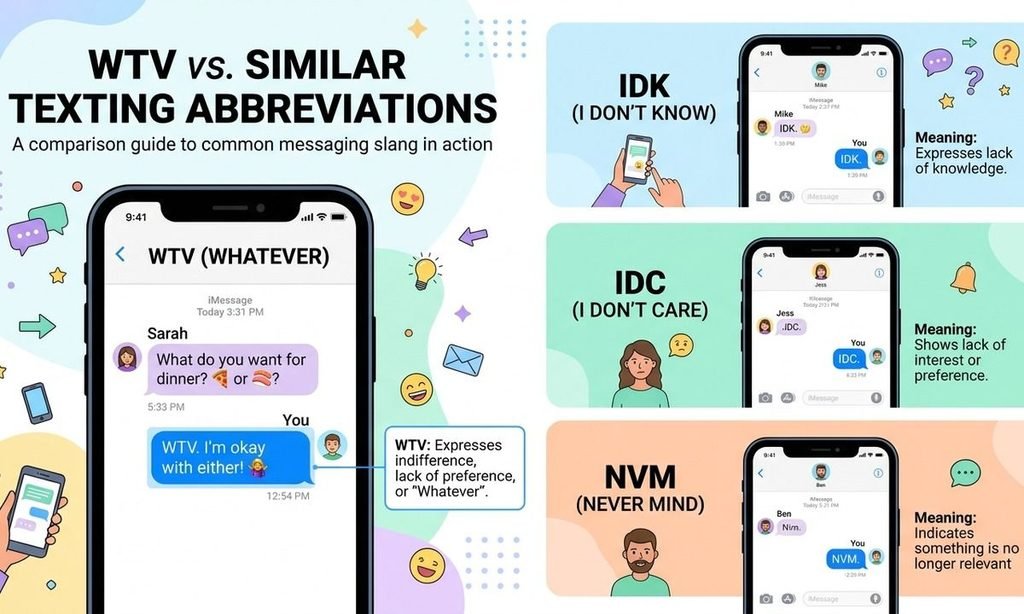
WTV has several cousins. They look alike but carry different weight.
Key Differences Between WTV and Related Terms
| Term | Meaning | Tone | How it differs from WTV |
| WTV | Whatever | Mild to dismissive | Flexible; tone depends on context |
| IDC | I don’t care | Stronger, more blunt | Clearly says you don’t care |
| IDK | I don’t know | Neutral | Shows uncertainty, not indifference |
| IDGAF | I don’t give a f*** | Very harsh | Rude and aggressive |
| NVM | Never mind | Neutral to annoyed | Drops the topic |
| K / KK | Okay | Flat or neutral | Agrees, but can feel cold |
| WTVR | Whatever | Same as WTV | Just a longer spelling |
In short: WTV is softer than IDC and much milder than IDGAF. It can also be friendly, which the others rarely are.
Quick rule of thumb: use WTV when the topic is small, like food, movies, or timing. Use clearer words when feelings, money, work, or serious plans are involved. This simple habit prevents most texting misunderstandings.
Common WTV Variations and Their Meanings
WTV is short for “whatever,” and it shows up in a few forms depending on the tone. “WTV” on its own usually means “I don’t mind” or “it’s fine with me,” while “wtvr” or “wtever” carry the same meaning in a slightly looser, more casual spelling.
1. WTV — The Standard Abbreviation
The plain form means “whatever.” Example: “wtv, I’m fine with anything.” It works as a quick answer in almost any casual chat.
2. WTV U Want — Expressing Indifference
This means “whatever you want.” It leaves the decision to the other person. Example: “Dinner at 8? wtv u want.” It can be kind or a little bored, depending on emojis.
3. WTV Works — Showing Flexibility
This one means “anything is fine with me.” Example: “Which day should we meet? wtv works.” It is a positive, cooperative phrase.
4. WTV Happens — Accepting the Outcome
This means you accept whatever result comes. Example: “We might lose, but wtv happens.” It sounds calm and carefree.
5. WTV LOL — Adding a Playful Tone
Adding “lol” softens the word instantly. Example: “wtv lol you win this time 😂.” It shows teasing, not anger.
6. WTV — A Short, Casual Response
Sometimes WTV stands alone as a lazy, quick answer. Example: “Movie or walk?” “wtv.” It may be neutral, but a lone word can feel cold, so add an emoji if you mean it nicely.
7. WTV Bro — Using WTV With Friends
This is friendly, casual banter. Example: “wtv bro, I’m in.” It sounds relaxed and shows you are comfortable with the person.
8. WTV Then — Ending a Conversation
This version often shows annoyance. Example: “Fine, wtv then.” It usually means the sender gives up or wants to stop talking.
9. Do WTV — Encouraging Someone to Do What They Want
This means “do whatever you like.” Example: “Do wtv makes you comfortable.” Tone matters here, because it can sound supportive or cold.
10. WTV Makes You Happy — Showing Acceptance
This is a warm phrase that supports someone’s choice. Example: “Take the job, wtv makes you happy 💛.” It is one of the kindest uses of WTV.
How to Reply When Someone Says WTV
Your reply should match the tone you sensed. First, decide whether the message was friendly, neutral, or upset. Then respond.
Casual Responses to WTV
Use these when the chat feels relaxed:
- “Cool, let’s go with that 👍”
- “Okay, I’ll pick then!”
- “Sounds good to me.”
Funny and Playful Replies to WTV
Use these with friends:
- “Wow, such enthusiasm 😂”
- “Okay, whatever-master, I’ll choose.”
- “That’s the most relaxed answer ever 😎”
Mature and Confident Ways to Respond to WTV
Use these when the tone feels tense:
- “It feels like something’s bothering you. Want to talk?”
- “I want your opinion too. What would you prefer?”
- “No pressure. We can finish this later.”
Polite Responses That Respect Personal Boundaries
Use these when you do not want to push:
- “No worries, I’ll check in with you later.”
- “Take your time. I’m here if you need me.”
- “All good. Let me know if you change your mind.”
Pro tip: Never reply with “wtv” back out of anger. It usually makes things worse. A calm message works better.
WTV Usage Across Different Regions and Cultures
WTV is part of English-language internet slang, but people read it a bit differently around the world.
WTV in Western Cultures
In the US, UK, Canada, and Australia, WTV is widely understood. It is common among teens and young adults. Many people see it as relaxed, though some find it rude if used in serious talks.
WTV in Asian Cultures
In many Asian countries, English slang is used in chats mixed with local languages. Politeness and respect matter a lot, so a blunt “wtv” to elders or seniors can feel disrespectful. Among peers, it is usually treated as casual.
WTV in Middle Eastern Cultures
In the Middle East and South Asia, many young people mix English abbreviations into Arabic, Urdu, or Hindi chats. Respect for family and elders is strong, so WTV is mostly kept for friends. Using it with older relatives may seem careless.
How WTV Is Used Across the Internet
Online, WTV appears in gaming chats, comment sections, and group messages. It is understood almost everywhere, since the internet shares slang quickly. Still, the tone always depends on the community and the people in it.
Voice and video chats rarely use WTV, because tone is easy to hear. It lives mainly in written messages, where short words stand in for facial expressions. That is also why emojis, punctuation, and capital letters matter so much when you read it, for example “WTV!!” versus “wtv…”
Conclusion
WTV simply means “whatever,” but its feeling changes with tone, emojis, punctuation, and the relationship between people. It can show flexibility, humor, or irritation. Variations like “wtvr” or “wtever” carry the same meaning in a looser, more casual spelling.
When you see WTV, look at the context before reacting. When you send it, think about how it will land, and use clearer words if the topic matters. Used wisely, WTV is a handy shortcut. Used carelessly, it can cause confusion.
Frequently Asked Questions
What Does WTV Mean in Text Messages?
WTV means “whatever.” It shows flexibility, indifference, or a wish to end a topic.
Is WTV Considered Rude or Disrespectful?
Not always. It is fine with friends in a light tone, but it can seem rude in serious or formal talks.
What Does WTV Mean When a Girl or Guy Uses It?
The meaning is the same for both: “whatever.” Check their usual texting style to know if they are relaxed or upset.
What Does WTV Mean on Snapchat and Instagram?
On both apps it means “whatever.” It is usually casual on Snapchat and can signal mild annoyance in Instagram DMs.
Is WTV Different From IDC?
Yes. IDC means “I don’t care” and sounds stronger, while WTV is softer and can be friendly.
What Is the Best Way to Reply to WTV?
Match the tone. Reply lightly to a friendly WTV, and ask calmly if it sounds upset.
Is It Appropriate to Use WTV in Professional Communication?
No. Use full phrases like “Either option works for me” at work or school.
