

DTB is one of those short texting terms that shows up everywhere from group chats to TikTok captions, yet very few people actually know all of its meanings. Most texters assume it only means one thing, but the truth is that DTB changes meaning depending on who sends it, where it is sent, and the tone behind the message.
In this guide, you will learn every common meaning of DTB, how it is used on TikTok, Snapchat, and Instagram, real text message examples, whether it is considered rude, and how you should respond when someone sends it to you. By the end, you will never be confused by DTB again.
What DTB Means in Text
DTB most commonly stands for Don’t Text Back, used when someone wants to end a conversation without expecting a reply. On social platforms like TikTok, it can also mean Don’t Trust Boys or Don’t Trust Bitches, a phrase tied to relationship distrust.
A smaller number of people also use it to mean Dios Te Bendiga, a Spanish phrase meaning God Bless You. The correct meaning depends entirely on context, tone, and the platform where it appears.
What Does DTB Stand For in Texting
DTB Means Don’t Text Back
This is the original and still the most widely used meaning of DTB in everyday texting. People add it to the end of a message when they are going to sleep, stepping into a meeting, or simply do not want a reply right now. It works as a polite way of saying the conversation can pause without anyone feeling ignored.
DTB Can Also Mean Don’t Trust Boys
This version became popular through relationship focused content on social media. It is usually used by women warning friends or followers about being cautious in dating situations, often after a bad experience or a breakup.
DTB Can Mean Don’t Trust Bitches in Slang
A rougher variation of the same idea, this meaning trended heavily on TikTok and is linked to lyrics from certain hip hop songs. It expresses distrust toward people in general, not specifically romantic partners, and is considered more informal and edgy.
Why the Meaning Changes With Context
Slang abbreviations rarely have one fixed definition because internet culture keeps reshaping them. DTB sits at the intersection of everyday texting shorthand and trending social media language, so its meaning shifts based on the sentence around it, the platform, and even the generation of the sender.
DTB Meaning on TikTok, Snapchat, and Instagram
Different apps tend to favor different interpretations of DTB. The table below breaks down how the term typically shows up on each platform.
| Platform | Common DTB Meaning | Typical Usage |
| Texting or SMS | Don’t Text Back | Ending a chat politely, going offline |
| TikTok | Don’t Trust Boys or Don’t Trust Bitches | Captions, comments, relationship trends |
| Snapchat | Don’t Text Back | Ending a streak conversation or chat |
| Either meaning depending on caption tone | Captions, DMs, story replies | |
| Twitter or X | Don’t Trust Bitches (slang) | Venting posts about betrayal or drama |
Because Snapchat and everyday SMS lean toward the practical Don’t Text Back meaning, while TikTok and Instagram often lean toward the relationship slang meaning, checking the platform is one of the fastest ways to figure out which version someone means.
How to Tell Which DTB Meaning Someone Means
Reading the full message rather than just the abbreviation is the easiest way to avoid confusion. Here are a few practical checks:
- Look at the words surrounding DTB, since a sentence like going to bed DTB clearly points to Don’t Text Back
- Consider your relationship with the sender, since close friends discussing dating often mean the distrust version
- Check the format, since captions and hashtags lean toward the social slang meaning while direct texts lean toward the practical meaning
- Pay attention to tone and emojis, since a sleepy emoji suggests Don’t Text Back while an angry or crying emoji suggests distrust slang
DTB Meaning in Different Texting Situations
The meaning of DTB often becomes obvious once you consider the situation it appears in.
When someone is going to sleep, DTB usually signals they are logging off for the night and do not expect a response until morning. When someone is busy at work or in class, it means they saw the message but cannot reply right now. When a conversation is naturally ending, it works as a casual sign off similar to talk later.
After an argument or breakup, DTB often shifts toward the distrust meaning, especially when paired with venting language. Between close friends, it is sometimes used as a lighthearted joke rather than a serious statement.
DTB Text Examples You Can Easily Understand
Seeing DTB used in real sentences makes the meaning much clearer than a plain definition. A few common examples include:
- Going to sleep now, DTB, which signals the sender does not expect a reply tonight
- At work right now, DTB, which politely explains why a response will be delayed
- Made it home safe, DTB, which closes the conversation on a reassuring note
- Girl DTB, used jokingly between friends discussing someone’s dating life
- A TikTok caption reading new year same DTB energy, referring to staying cautious around people who cannot be trusted
Is DTB a Bad or Rude Word
DTB itself is not offensive when used in its basic Don’t Text Back form. It becomes questionable mainly when it carries the harsher Don’t Trust Bitches interpretation, since that phrase includes language some people consider vulgar.
Used with close friends in casual settings, DTB is completely normal and rarely causes offense. Sent bluntly with no explanation, it can sound cold, dismissive, or even passive aggressive, especially to someone who does not expect it.
It is best avoided in formal, professional, or unfamiliar conversations, since coworkers or new contacts may not understand the abbreviation or may find it unprofessional. In workplace texting or emails, spelling out the full sentence is always the safer choice.
Related Post: What Does TTH Mean in Text? Full Meaning, Examples, and How to Reply
How Do You Respond to DTB in a Text
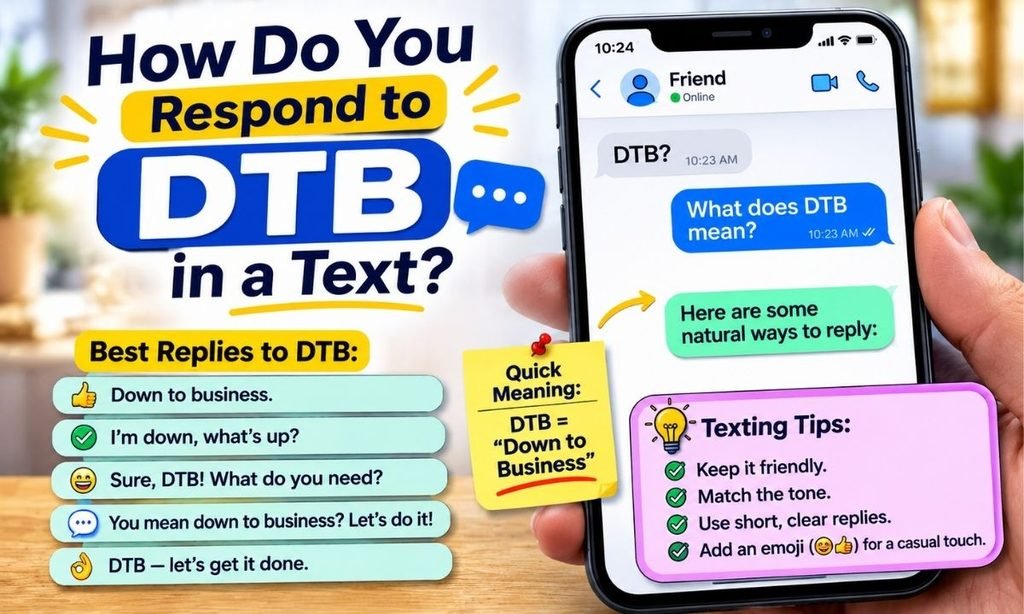
If DTB means Don’t Text Back, the simplest and most respectful response is often no response at all, since replying defeats the purpose of the message. If you want to acknowledge it briefly, a short reply like okay or talk soon works well without pressuring the other person to keep chatting.
Among friends, a playful response such as fine, I won’t is common and keeps the tone light. If you are unsure which meaning was intended, it is completely fine to ask directly what someone meant rather than guessing and risking a misunderstanding.
Other Meanings of DTB You Should Know
Outside of texting, DTB occasionally appears in a few unrelated contexts. In business and casual professional slang, some people use DTB to mean Down to Business, signaling they want to skip small talk and focus on the task at hand. In music and rap culture, DTB gained popularity through lyrics associated with distrust themes, which helped push the phrase into mainstream slang.
In Spanish speaking communities, DTB sometimes stands for Dios Te Bendiga, a warm phrase meaning God Bless You, commonly used in messages between family members. Because these meanings are far less common than the texting definitions, it is important not to assume every DTB you see refers to the same thing.
DTB vs Similar Texting Abbreviations
DTB is often grouped with other short texting terms that also signal the end of a conversation. Here is how they compare.
| Abbreviation | Meaning | When It Is Used |
| DTB | Don’t Text Back | Ending a chat, going offline |
| TTYL | Talk to You Later | Casual goodbye, expecting future contact |
| BRB | Be Right Back | Short pause during an active conversation |
| GTG | Got to Go | Leaving suddenly, often urgent |
| NVM | Never Mind | Dropping a topic or canceling a request |
| IDC | I Don’t Care | Expressing indifference to a decision |
While TTYL and GTG both imply the conversation will continue later, DTB specifically signals that a reply is not needed right now, making it slightly more direct than the others.
The Origin and History of DTB
DTB is not a brand new term. Variations of Don’t Text Back have circulated in texting culture since smartphones made constant messaging the norm, largely as a shorthand way to set expectations without sounding rude.
The distrust version, Don’t Trust Bitches or Don’t Trust Boys, has more recent roots and is widely linked to hip hop lyrics that were later remixed into short form videos.
Once TikTok creators began pairing the phrase with breakup stories and dating advice content, it spread quickly and picked up its own separate identity from the original texting abbreviation.
DTB in Gen Z and Internet Culture
Gen Z communication favors short, expressive phrases that carry emotional weight in very few characters, and DTB fits that pattern perfectly. It works both as a practical texting shortcut and as an identity marker in captions, showing that someone is confident, cautious, or simply done explaining themselves.
This dual identity is exactly why the same three letters can appear in a sleepy goodnight text and in a bold TikTok caption about relationships without feeling out of place in either context.
Is DTB Used in Flirting or Dating Conversations
DTB does show up in dating conversations, though rarely as a flirtatious term on its own. In flirty exchanges, it usually appears in its practical sense, such as heading to bed, DTB, cutie, where it softens a goodnight message.
In more guarded dating contexts, particularly after being hurt before, someone might reference DTB energy to signal they are protecting their emotions rather than genuinely inviting further conversation. Understanding which version is being used can prevent an awkward misread of someone’s intentions.
DTB in Gaming and Online Communities
Inside gaming chats and Discord servers, DTB is typically used in its simplest form, meaning a player is stepping away and does not need messages piling up while they are gone.
Because gaming communities value speed and clarity during matches, the practical Don’t Text Back meaning dominates here far more than the relationship slang version, which is mostly confined to social media captions rather than live chat during gameplay.
How to Pronounce and Use DTB Correctly
DTB is typically read letter by letter as D T B rather than as a single word, similar to other texting acronyms like OMG or BRB. When using it in a message, placing it after the main sentence, such as heading out now DTB, keeps the meaning clear and avoids sounding abrupt.
Avoid opening a message with DTB alone, since without context it can easily come across as confusing or even dismissive to someone unfamiliar with the term.
Related Post: Louisiana Slang Words and Phrases: A Local’s Guide to Cajun, Creole, and New Orleans Sayings
Why Is DTB So Common in Online Slang
Short abbreviations like DTB thrive because they let people communicate quickly without losing meaning. Faster typing on mobile keyboards naturally pushes users toward shorthand, and platforms like TikTok and Snapchat reward brief, punchy captions over long sentences.
Dating and relationship conversations also generate a steady stream of new slang, since people constantly look for quick ways to express trust, distrust, or emotional boundaries. As texting habits keep evolving, terms like DTB will likely continue shifting meaning, proving that internet language is always a work in progress rather than a fixed dictionary entry.
Conclusion
DTB is a flexible texting abbreviation that mostly means Don’t Text Back in everyday conversations, while also carrying a completely different relationship focused meaning on platforms like TikTok.
Rather than memorizing a single definition, the smartest approach is to read the full message, consider the platform, and pay attention to tone before deciding how to respond. Once you know all the possible meanings, DTB stops being confusing and becomes just another simple piece of everyday texting shorthand.
Frequently Asked Questions
What does DTB mean in a text from a girl?
It usually means Don’t Text Back, though in relationship talk it can also mean Don’t Trust Boys depending on context.
What does DTB mean in a text from a guy?
Most often it simply means Don’t Text Back, used to end a conversation politely without expecting a reply.
What does DTB mean on TikTok?
On TikTok, DTB is commonly used to mean Don’t Trust Boys or Don’t Trust Bitches, tied to relationship and breakup content.
What does DTB mean on Snapchat?
On Snapchat, DTB almost always means Don’t Text Back, used to pause a conversation or streak a reply.
Is DTB a bad word?
No, DTB itself is not a bad word, though its slang variation includes language some consider inappropriate for formal settings.
Is DTB rude?
It can sound blunt if sent without explanation, but with friends and casual context it is generally seen as normal.
What does DTB mean in slang?
In slang, DTB often refers to Don’t Trust Bitches or Don’t Trust Boys, expressing distrust after being hurt or betrayed.
Should I reply to DTB?
Not necessarily, since the whole point of DTB is that a reply is not expected, though a short acknowledgment is fine.
What does DTB mean after a breakup?
After a breakup, DTB is frequently used in its distrust sense, warning others to be cautious in future relationships.
Does DTB always mean Don’t Text Back?
No, the meaning changes based on platform and tone, so it is important to read the full message before assuming.
