
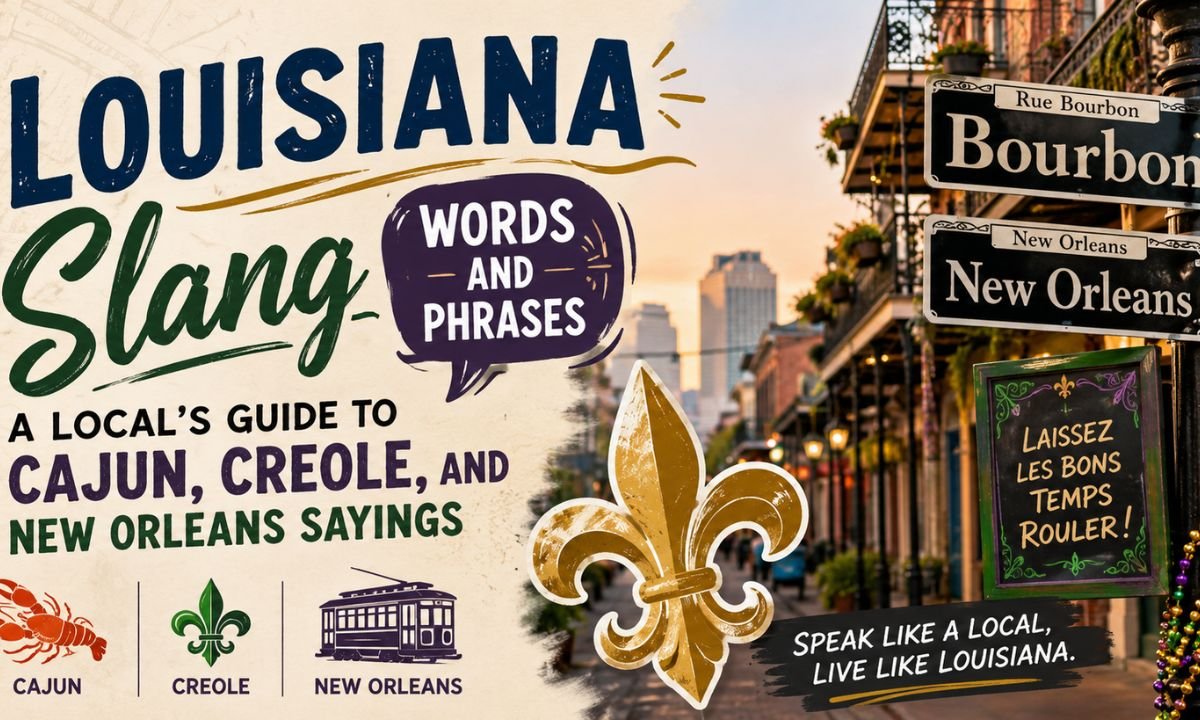

Louisiana speaks a language all its own. Between French-rooted Cajun expressions, Creole flavor, and the singsong rhythm of a New Orleans “Yat” accent, first-time visitors often feel like they need a translator just to order a po’boy or ask for directions.
This guide breaks down the words and phrases you’ll actually hear on the street, at a crawfish boil, or during Mardi Gras, along with where they come from and how locals really use them. By the end, you’ll be able to hold a conversation without missing a beat.
Why Louisiana Talk Sounds Nothing Like Anywhere Else
Louisiana’s vocabulary grew out of three centuries of overlapping cultures. French settlers, Acadian exiles (the ancestors of today’s Cajuns), Spanish colonists, West African communities, and Caribbean Creole traditions all shaped the language spoken in the bayous and city streets.
Add a strong Southern drawl on top of that mix, and you get a dialect that changes noticeably depending on which parish you’re standing in.
New Orleans itself sounds closer to Brooklyn than to the Deep South in places, thanks to waves of Irish, Italian, and German immigrants who settled in the same working class neighborhoods generations ago. That’s part of why “Yat” speech, named for the greeting “where y’at,” has its own distinct twang separate from rural Cajun Country.
Everyday Louisiana Slang You’ll Hear Constantly
These are the words that show up in ordinary conversation, no matter what part of the state you’re visiting.
Cher
Pronounced “sha,” this French term of endearment means dear or sweetheart and gets used with strangers and loved ones alike.
Making Groceries
Borrowed directly from the French phrase “faire son marché,” this simply means going grocery shopping.
Neutral Ground
What most of the country calls a median, New Orleans calls neutral ground, a term dating back to when Canal Street separated French and American sections of the city.
Lagniappe
Pronounced “lan yap,” it means a little something extra thrown in for free, like a baker’s dozen.
Fixin’ To
A Southern staple that also lives comfortably in Louisiana speech, meaning about to do something.
Podna
A relaxed version of “partner,” used the way other regions might say buddy or pal.
Tore Up
Used to describe something worn out, broken down, or in rough shape, whether it’s a car or a person’s mood.
Table: Quick Reference for Common Louisiana Words
| Word or Phrase | Meaning | Where You’ll Hear It |
| Cher | Dear, sweetheart | Statewide |
| Making groceries | Grocery shopping | Statewide |
| Neutral ground | Road median | New Orleans |
| Lagniappe | A little something extra | Statewide |
| Podna | Friend, partner | New Orleans |
| Dressed | Fully loaded (sandwich) | Statewide |
| Fais do-do | Cajun dance party | Acadiana |
| Couyon | A foolish or silly person | Cajun Country |
New Orleans Yat Expressions Every Visitor Should Know
Yat speech is its own dialect within Louisiana, built around a fast, clipped accent and a handful of signature phrases.
Where y’at functions as a full greeting, roughly equivalent to “how’s it going.” The proper response is almost always yeah you right, which simply confirms agreement or affirms something is true.
Locals also refer to extended family or a friend group collectively as ya mamma’n’em, and they’ll casually invite someone to pass by the house, meaning stop in for a visit rather than actually driving past it.
Bartenders across the French Quarter hand out a go-cup so patrons can legally carry a drink outside, one of the few places in the country where that’s normal practice.
Cajun Country Sayings Rooted in French
Head west into Acadiana and the vocabulary shifts toward its French Louisiana roots.
- Fais do-do describes a traditional Cajun dance party, often held outdoors with a live band.
- Couyon labels someone acting foolish or reckless, said with more amusement than insult.
- Envie refers to a craving, most often used for food.
- Choupique is the Cajun name for bowfin, a fish common in local bayous.
- Lâche pas la patate literally translates to “don’t drop the potato,” a Cajun expression for don’t give up.
- Laissez les bons temps rouler rounds out the list as the state’s unofficial motto, meaning let the good times roll.
Food Words That Confuse First-Time Visitors
Ordering food in Louisiana comes with its own vocabulary, and getting it right earns instant respect from behind the counter.
Ask for a po’boy dressed and you’ll get it loaded with lettuce, tomato, pickles, and mayonnaise. The holy trinity refers to the onion, celery, and bell pepper base that starts almost every Cajun and Creole dish, standing in for the French mirepoix.
Boudin is a Cajun sausage packed with rice and pork, while cracklin’ describes fried pork skin seasoned heavily and eaten as a snack. A sno-ball is shaved ice soaked in syrup, distinct from a mainland snow cone because the ice is shaved finer and packed looser.
Related Post: Slang Word for Cool: 50+ Trendy Ways to Say It in 2026
Mardi Gras Words You Need Before Parade Season
Carnival season brings its own vocabulary that locals use without thinking twice.
A krewe is the private club or organization that plans and funds a parade, and each krewe’s members ride on floats tossing a throw, which can be beads, cups, or decorated coconuts depending on the group.
King cake shows up at every office and gathering from January through Fat Tuesday, and whoever finds the small plastic baby baked inside typically buys the next one. Lundi Gras, the Monday before Fat Tuesday, kicks off the final stretch of celebrations before Ash Wednesday arrives.
Table: Mardi Gras Terms and What They Mean
| Term | Meaning |
| Krewe | Organization that runs a parade |
| Throw | Beads, cups, or trinkets tossed from floats |
| King cake | Traditional cinnamon pastry with a hidden baby figurine |
| Lundi Gras | The Monday before Fat Tuesday |
| Second line | A parade tradition where onlookers join the procession |
| Flambeaux | Torch carriers who light nighttime parade routes |
Where Louisiana Slang Shows Up in Music and Branding
Local musicians and businesses lean heavily on regional vocabulary to signal authenticity. Bounce and brass band lyrics regularly drop terms like “where y’at” and “who dat,” and tourism boards use words like lagniappe in slogans to promise visitors something extra beyond the standard trip.
Restaurants name menu items after Cajun French terms, and local breweries and shops brand entire product lines around phrases like “laissez les bons temps rouler,” turning everyday slang into a marketing shorthand that instantly signals Louisiana pride.
How to Use Louisiana Slang Respectfully as a Visitor
Visitors are usually welcomed warmly for trying out local phrases, but a few habits go a long way. Use terms like cher or podna naturally rather than performing an exaggerated accent, and avoid mocking or over correcting a local’s pronunciation of their own words.
It also helps to ask locals directly what a phrase means rather than guessing, since meanings can shift slightly between New Orleans, Acadiana, and North Louisiana.
Related Post: Addy Slang Meaning: What Does “Addy” Mean in Text?
Common Mistakes Outsiders Make With Local Terms
New visitors often assume “parish” is a religious reference, when it’s actually just Louisiana’s version of a county, a holdover from the state’s Catholic colonial administration.
Another frequent mix up is treating “dressed” as optional, when leaving it off a po’boy order can genuinely surprise a local server. Tourists also tend to mispronounce lagniappe and Tchoupitoulas Street, both of which have French based pronunciations that don’t follow standard English rules.
Louisiana Slang by Region
- New Orleans leans into Yat speech, with a fast accent and phrases shaped by Irish and Italian immigrant history.
- Cajun Country and Acadiana carry the heaviest French influence, especially in rural parishes.
- Baton Rouge blends Southern English with lighter Cajun and Creole touches.
- North Louisiana sounds closer to general Southern dialects found in Mississippi and Arkansas.
- Bayou communities preserve older Cajun French vocabulary that’s fading elsewhere in the state.
Frequently Asked Questions
What does cher mean in Louisiana?
Cher, pronounced sha, is a French term of affection meaning dear or sweetheart, used casually with friends, family, and strangers alike.
What does lagniappe mean?
Lagniappe means a small extra gift or bonus thrown in with a purchase, a tradition rooted in Louisiana’s French and Spanish colonial history.
What does where y’at mean?
It’s a casual greeting used mainly in New Orleans, equivalent to asking how’s it going or what’s up.
What does making groceries mean?
It simply means going grocery shopping, a direct translation from the French phrase faire son marché.
What does neutral ground mean in New Orleans?
It refers to the median strip between lanes of traffic, a term unique to the New Orleans area.
What does dressed mean on a po’boy?
Ordering a sandwich dressed means it comes with lettuce, tomato, pickles, and mayonnaise included.
What is a popular Cajun phrase tourists should learn?
Laissez les bons temps rouler, meaning let the good times roll, is the most recognized Cajun phrase across the state.
Final Thoughts
Louisiana’s slang reflects the same layered history found in its food, music, and festivals. Learning even a handful of these words, from a simple cher to a full laissez les bons temps rouler, makes it easier to connect with locals and enjoy the culture the way it’s meant to be experienced.
Whether you’re navigating a menu, a parade route, or a casual conversation on the porch, this vocabulary is part of what makes Louisiana feel unlike anywhere else in the country.

1 thought on “Louisiana Slang Words and Phrases: A Local’s Guide to Cajun, Creole, and New Orleans Sayings”