
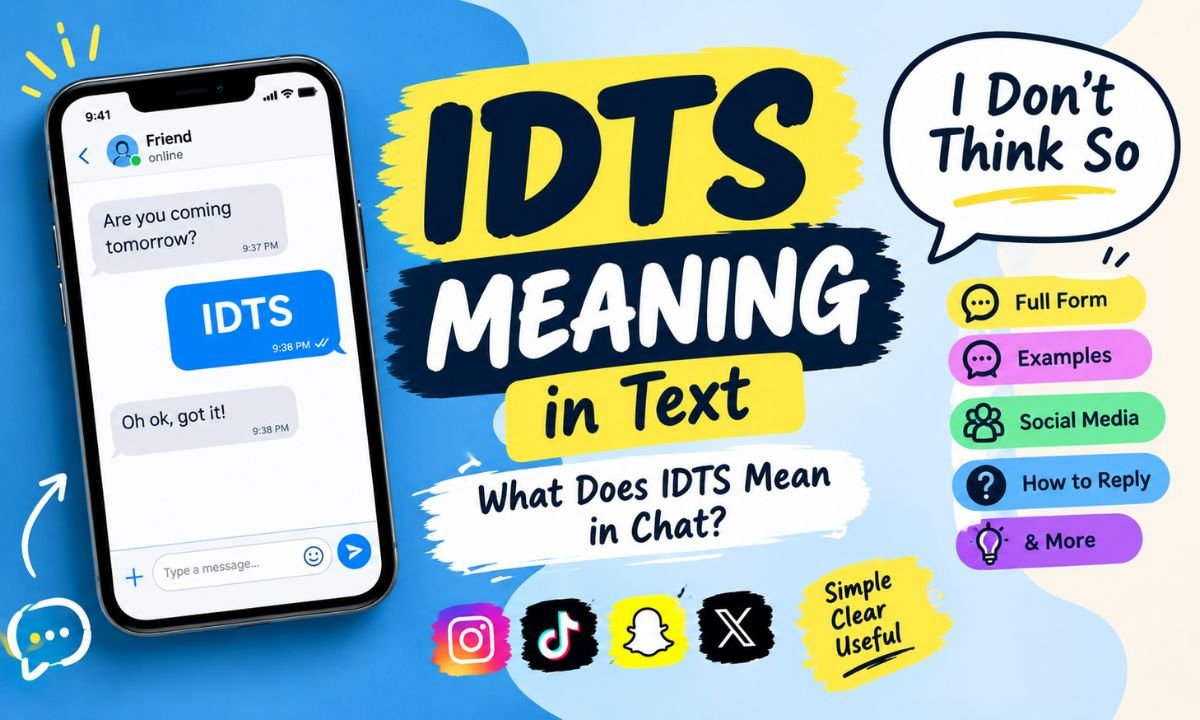

If you’ve seen “IDTS” pop up in a text thread or a comment section and paused to figure it out, you’re not alone. Short texting abbreviations like this one move fast across group chats, DMs, and social apps, and their meaning can shift slightly depending on who’s typing and what mood they’re in.
In simple terms, IDTS stands for “I Don’t Think So.” People use it to express doubt, mild disagreement, uncertainty, or a soft way of saying no without sounding harsh. This guide breaks down exactly how it’s used, where it shows up, and how to respond when someone sends it to you.
What Does IDTS Mean in Text?
IDTS is a texting initialism that stands for “I Don’t Think So.” It’s typically used to signal disagreement, hesitation, or a gentle refusal in casual conversation.
IDTS Full Form
The full form of IDTS is simply “I Don’t Think So,” written out letter by letter rather than pronounced as a single word.
IDTS Meaning in Simple Words
In plain language, IDTS is a quick way of saying “probably not” or “I doubt it” without typing the whole phrase.
What Does IDTS Stand For?
It stands for four words condensed into four letters: I, Don’t, Think, So — a shorthand built for fast-paced digital conversation.
IDTS Meaning in Chat and Text Messages
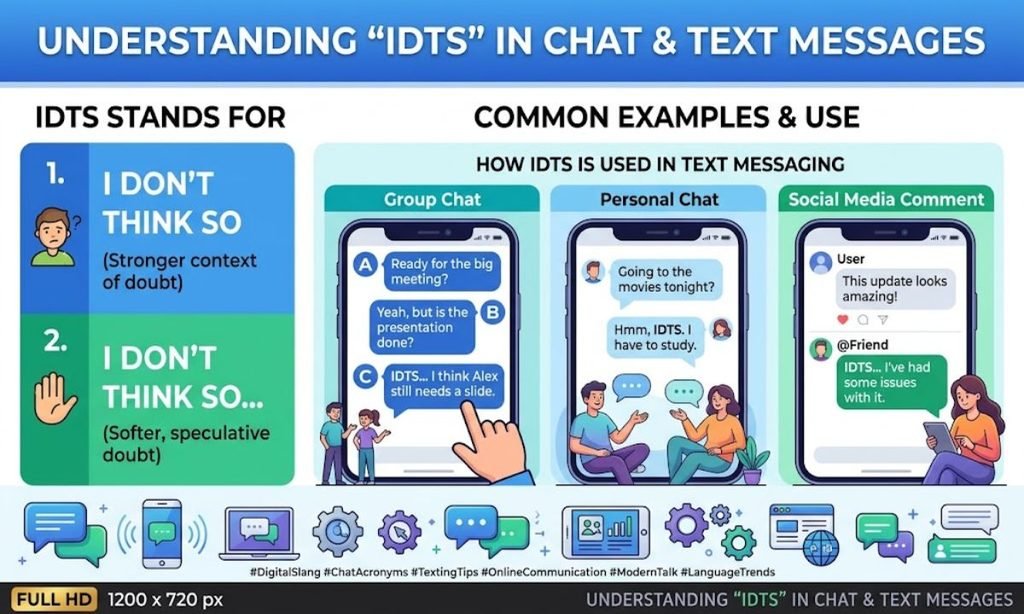
In everyday chats, IDTS usually shows up as a quick reply to a question or suggestion someone isn’t fully on board with.
How IDTS Is Used in Everyday Chats
Friends often drop IDTS when they’re skeptical about a plan, an idea, or a piece of information someone just shared.
What IDTS Means When Someone Replies “IDTS”
A one-word reply of “IDTS” almost always signals mild pushback — it’s rarely a hard no, more of a “I’m not convinced.”
Is IDTS a Yes or No?
IDTS leans toward “no,” but it’s softer than an outright refusal, leaving room for more discussion.
What Does IDTS Mean on Social Media?
Across social platforms, IDTS carries the same core meaning but adapts to the tone of each app.
IDTS Meaning on Instagram
On Instagram comments and DMs, IDTS often appears as a casual reaction to a post’s claim or caption.
IDTS Meaning on TikTok
TikTok comment sections use IDTS to challenge a video’s point, often mixed with humor rather than genuine hostility.
IDTS Meaning in Snapchat and DMs
In private messages, IDTS tends to feel more personal and direct, often exchanged between close friends.
IDTS in Group Chats and Comments
In group settings, IDTS can trigger a quick back-and-forth as others weigh in with their own opinions.
The Origin and History of IDTS
Like many texting abbreviations, IDTS grew out of early SMS culture, when character limits and slow typing speeds pushed people to shorten common phrases. As instant messaging and mobile keyboards became standard, these shortcuts carried over into apps like WhatsApp, Discord, and social media comment sections, where speed still matters more than formality.
How to Use IDTS in a Conversation
Knowing when to drop IDTS naturally into a chat helps it land the way you intend.
Using IDTS to Express Doubt
Use it when you’re unsure a claim or plan is accurate or realistic.
Using IDTS to Disagree
Use it as a lighter alternative to a blunt “no” when pushing back on someone’s idea.
Using IDTS as a Soft No
Pair it with an emoji or a follow-up sentence to keep the tone friendly.
Using IDTS When You Are Unsure
It also works when you genuinely don’t have enough information to agree confidently.
IDTS Meaning and Tone: What Does It Really Sound Like?
Tone is where IDTS gets tricky, since the same three letters can read very differently depending on context.
Can IDTS Sound Polite?
Yes, especially when followed by an explanation or a softer emoji.
Can IDTS Sound Rude or Dismissive?
Sent alone, with no punctuation or follow-up, it can come across as blunt or dismissive.
When IDTS Sounds Playful or Sarcastic
Among close friends, IDTS is often used jokingly to tease rather than genuinely disagree.
How Emojis and Punctuation Change the Tone
A laughing emoji softens it; a period or all caps can make it feel sharper.
IDTS Meaning With Examples
Seeing IDTS in real conversation examples makes the meaning click faster.
IDTS Texting Examples With Friends
“Are we still meeting at 6?” — “IDTS, traffic looks bad today.”
IDTS Examples in Group Chats
“IDTS everyone can make it Friday, let’s check first.”
IDTS Examples for Questions
“Will it rain tomorrow?” — “IDTS, the forecast looks clear.”
Funny and Casual IDTS Examples
“IDTS pineapple belongs on pizza, but you do you.”
IDTS Examples With Emojis
“IDTS 😅 but let’s try it anyway.”
Common Mistakes People Make When Using IDTS
A few habits can make IDTS land wrong. Common slip-ups include:
- Using it in formal or professional writing where clarity matters more than speed
- Sending it with no context, leaving the other person confused about what’s being doubted
- Overusing it in every reply, which can come across as constantly negative
- Pairing it with harsh punctuation that makes a soft disagreement feel like a hard rejection
- Assuming the receiver will always read the intended tone correctly
How to Reply When Someone Says IDTS
Responding well to an IDTS keeps the conversation moving instead of stalling it.
Friendly Replies to IDTS
“Fair enough, what do you think instead?”
Funny Replies to IDTS
“IDTS to your IDTS 😂”
How to Respond When IDTS Means “Probably Not”
Ask a clarifying question, like “why not?” to understand the hesitation.
What to Say if You Disagree With Their IDTS
Explain your reasoning calmly rather than repeating your original point.
Is IDTS an Acronym or Abbreviation?
Technically, IDTS is best classified as an initialism rather than a true acronym.
Is IDTS Technically an Initialism?
Yes — it’s read letter by letter (I-D-T-S), not pronounced as one word, which makes it an initialism.
How the Letters in IDTS Stand for “I Don’t Think So”
Each letter maps directly to one word in the full phrase, with no added or hidden meaning.
IDTS vs Similar Texting Abbreviations
| Abbreviation | Meaning | Typical Use |
| IDTS | I Don’t Think So | Expressing doubt or mild disagreement |
| IDK | I Don’t Know | Expressing lack of information |
| IMO | In My Opinion | Sharing a personal viewpoint |
| TBH | To Be Honest | Prefacing a candid remark |
| NGL | Not Gonna Lie | Admitting something frankly |
IDTS vs IDK
IDTS expresses doubt about something specific; IDK simply admits a lack of knowledge.
IDTS vs IMO
IMO introduces a personal opinion; IDTS pushes back on someone else’s claim.
IDTS vs TBH
TBH signals honesty in general; IDTS specifically signals disagreement or skepticism.
IDTS vs NGL
NGL admits something the speaker might normally hide; IDTS is purely about doubting an idea.
IDTS vs “I Don’t Think So”
They mean exactly the same thing — IDTS is just the faster, informal version.
IDTS in Gaming and Online Communities
In gaming chats and platforms like Discord, IDTS often shows up during quick strategy debates or when someone questions a teammate’s call, fitting into the fast, clipped communication style typical of live voice-and-text gaming culture.
Is IDTS Appropriate to Use at Work?
Workplace tone matters, so it’s worth knowing when IDTS fits and when it doesn’t.
When IDTS Is Fine in Casual Work Chats
Informal Slack channels or messages between close coworkers can usually handle IDTS without issue.
When to Write “I Don’t Think So” Instead
Emails, client messages, and formal reports should always spell the phrase out fully.
Professional Alternatives to IDTS
Phrases like “I’m not sure that’s accurate” or “I have some doubts about this” work better in professional settings.
The Psychology Behind Saying IDTS
Choosing a soft abbreviation like IDTS over a flat “no” often reflects a desire to disagree without damaging the tone of a conversation — it signals hesitation while still leaving room for the other person to explain or push back.
Frequently Asked Questions
What Does IDTS Mean in Texting?
It means “I Don’t Think So,” used to express doubt or mild disagreement.
What Does IDTS Mean in Chat?
The same meaning applies in chat apps as in text messages.
What Is the Full Form of IDTS?
The full form is “I Don’t Think So.”
Does IDTS Mean “I Don’t Think So”?
Yes, that is its standard and most common meaning.
Is IDTS a Slang Word?
It’s more accurately an informal initialism than traditional slang.
Is IDTS Rude?
Not inherently — tone and context determine whether it feels rude or casual.
How Do You Respond to IDTS?
Ask why, share your own view, or simply acknowledge it and move the conversation forward.
Conclusion
IDTS stands for “I Don’t Think So” and is used across texting, chat apps, and social media to express doubt, disagreement, or a soft no. Its tone shifts depending on punctuation, emojis, and the relationship between the people talking, so context always matters more than the letters themselves. Once you recognize it, replying naturally becomes second nature.
