
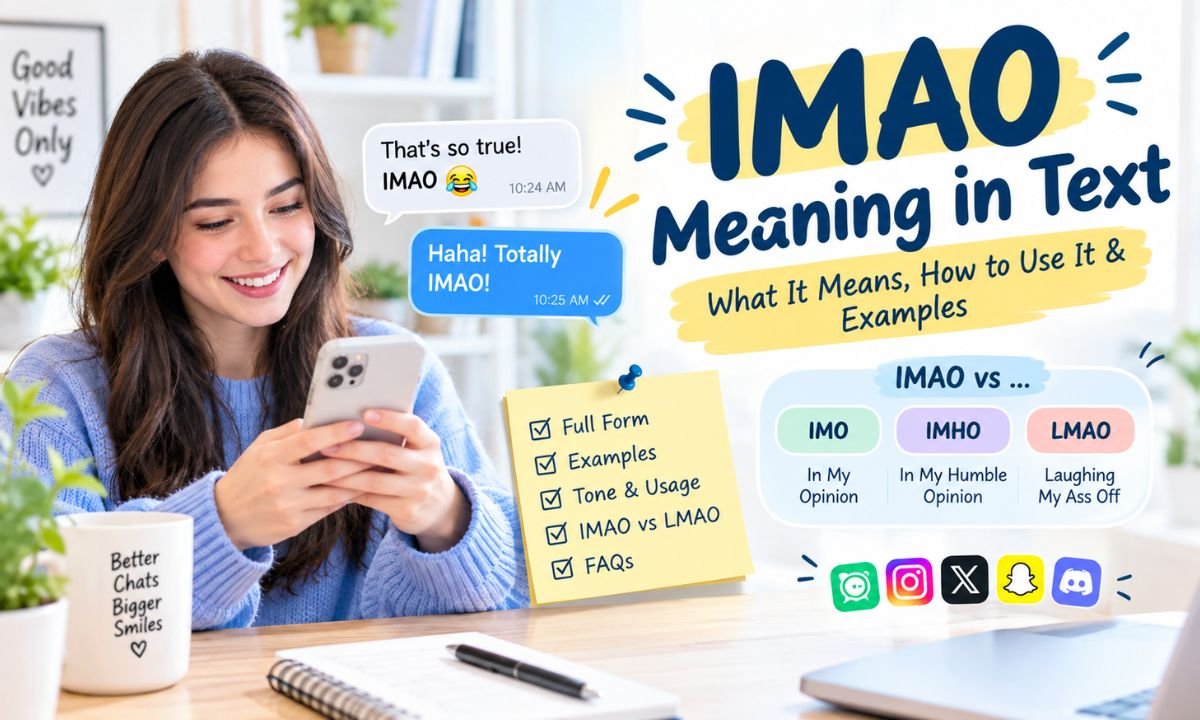

IMAO usually stands for “In My Arrogant Opinion.” It is an informal internet abbreviation people use when sharing a personal view in a playful, confident, or exaggerated way. It is meant to sound humorous rather than genuinely conceited.
Sometimes lowercase “imao” gets confused with “LMAO,” so the surrounding message matters when deciding what the writer actually meant. This guide explains the full meaning, correct usage, tone, and how IMAO compares to similar internet slang.
What Does IMAO Mean in Text?
IMAO stands for “In My Arrogant Opinion.” People use it to introduce a viewpoint with intentional overconfidence, often as a joke rather than a literal claim of arrogance.
What Does IMAO Stand For?
It stands for In My Arrogant Opinion, a humorous twist on the more common IMO and IMHO.
What Is the Simple Meaning of IMAO?
It simply means the writer is sharing an opinion while jokingly exaggerating their own confidence in it.
Is IMAO a Slang Word or Abbreviation?
It is a texting and internet abbreviation, not a formal word, and belongs to the same family as LOL, IMO, and IMHO.
IMAO Full Form and Meaning Explained
I = In
Sets up the phrase as a personal statement.
M = My
Indicates the opinion belongs specifically to the writer.
A = Arrogant
Adds a deliberately exaggerated, tongue in cheek tone to the opinion.
O = Opinion
Confirms that what follows is a viewpoint, not a fact.
What Does “Arrogant” Add to the Meaning?
The word “arrogant” is what separates IMAO from plain opinion markers; it signals the writer is being playfully bold rather than seriously boastful.
How Is IMAO Used in Texting?
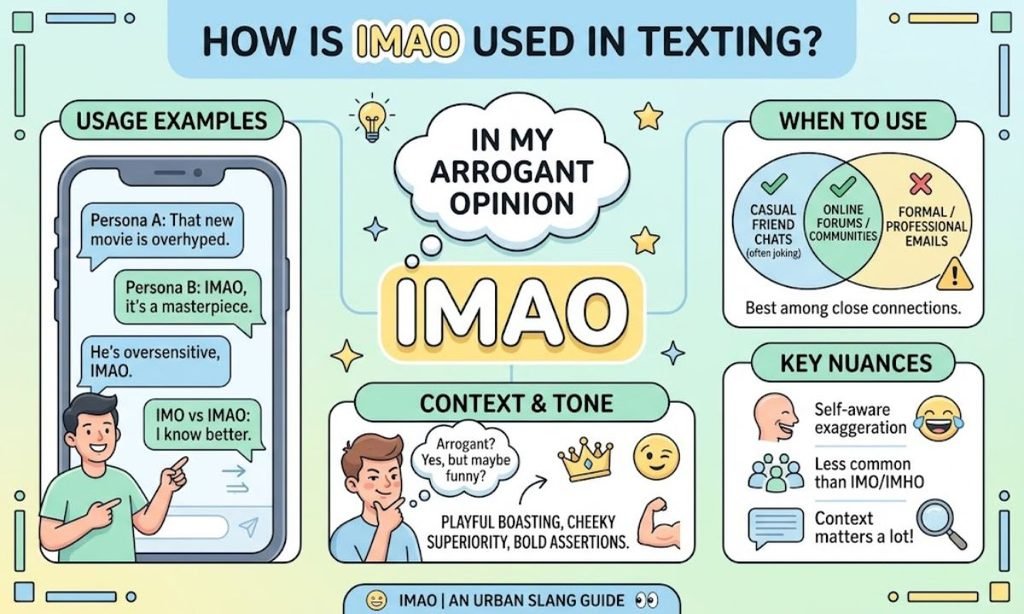
IMAO Before Giving an Opinion
Placed at the start of a sentence, it sets a confident, joking tone before the statement.
IMAO After a Statement
Placed at the end, it softens a bold claim by framing it as exaggerated opinion.
IMAO in Casual Conversations
It fits naturally into texts between friends discussing movies, food, sports, or everyday debates.
IMAO in Online Discussions
In forums and comment threads, it signals a strong stance shared with humor rather than hostility.
IMAO Meaning in Chat and Social Media
IMAO Meaning in Text Messages
The meaning stays consistent: a playful, opinionated statement.
IMAO Meaning on Instagram
Commonly used in captions or comments to add a joking, confident spin to a statement.
IMAO Meaning on TikTok
Used in comment sections to express a strong take on a video in a lighthearted way.
IMAO Meaning on Snapchat
Appears in captions or chats, usually among close friends who understand the joking tone.
IMAO Meaning in Discord and Gaming Chats
Common when players share confident, sometimes exaggerated takes on gameplay or strategy.
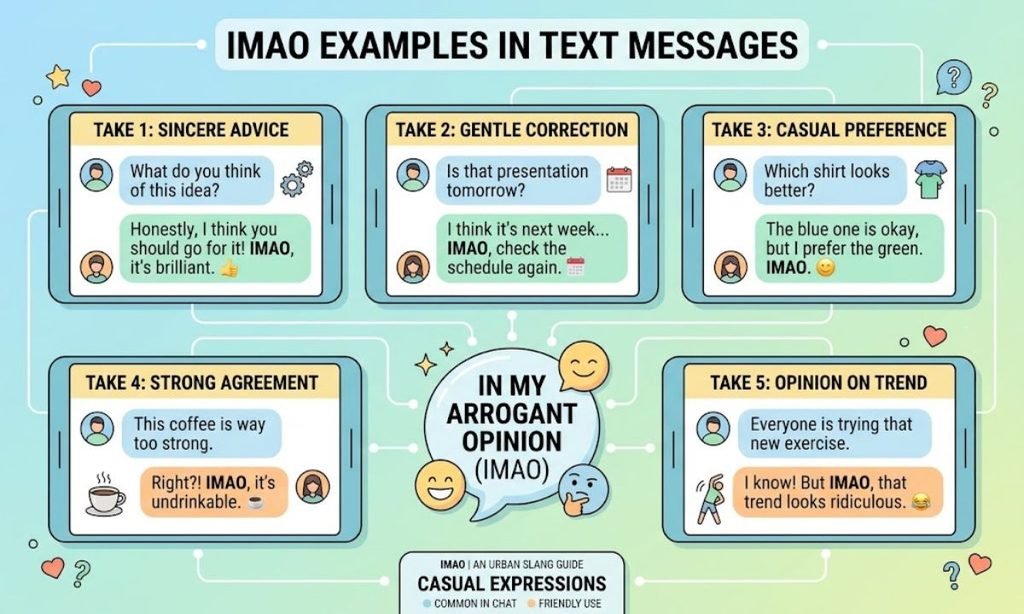
IMAO Examples in Text Messages
Funny IMAO Examples
“IMAO, pineapple absolutely belongs on pizza.”
IMAO Examples for Sharing an Opinion
“IMAO, this is the best season of the show so far.”
Sarcastic IMAO Examples
“IMAO, I basically invented this dance move.”
IMAO Examples Between Friends
“IMAO, you always pick the worst restaurants, but I still show up.”
IMAO Examples in Online Discussions
“IMAO, this update fixed everything wrong with the game.”
IMAO Examples With Emojis
“IMAO, this is the best pizza in town.” The playful tone here shows the person is jokingly expressing a very confident opinion rather than a literal boast.
IMAO vs IMO: What’s the Difference?
| Abbreviation | Meaning | Typical Tone |
| IMO | In My Opinion | Neutral |
| IMAO | In My Arrogant Opinion | Playful, confident |
| IMHO | In My Humble Opinion | Humble, cautious |
IMO Meaning
A neutral way to share a personal opinion without extra tone.
IMAO Meaning
A playful variation that adds humor and exaggerated confidence.
Why IMAO Sounds More Playful Than IMO
The word “arrogant” injects intentional humor, making the statement feel less serious than a plain IMO.
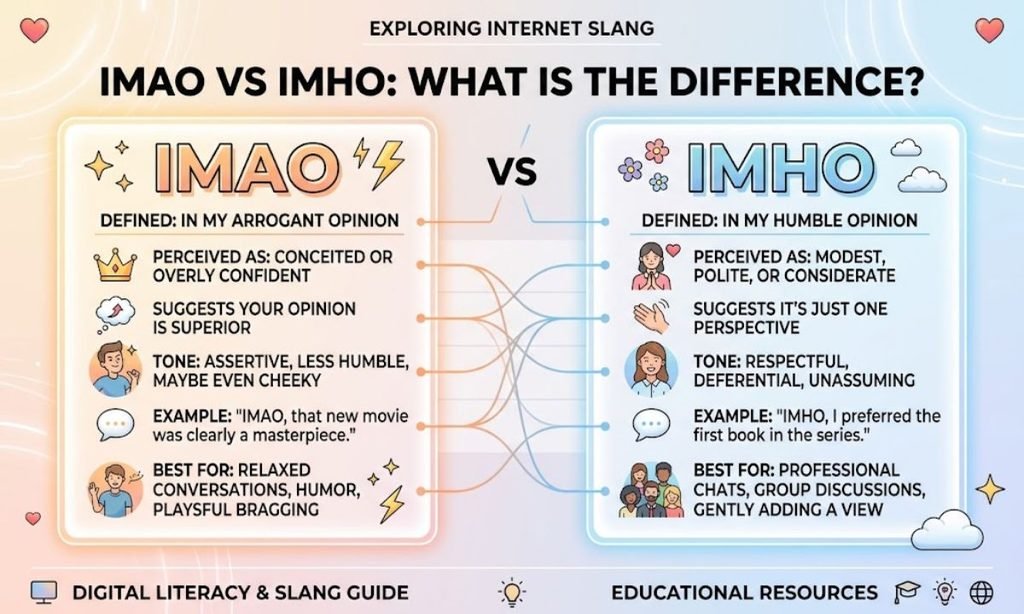
IMAO vs IMHO: What Is the Difference?
What Does IMHO Mean?
It means “In My Humble Opinion,” signaling modesty rather than confidence.
How IMAO Changes the Tone
IMAO flips that humility into exaggerated self assurance for comedic effect.
Which One Sounds More Humble?
IMHO sounds more humble, while IMAO intentionally sounds the opposite.
IMAO vs LMAO: Are They the Same?
What Does LMAO Mean?
LMAO means “Laughing My Ass Off,” used to express strong laughter.
What Does IMAO Mean?
IMAO means “In My Arrogant Opinion,” used to introduce a viewpoint.
Why Do People Confuse IMAO With LMAO?
The similar letter pattern and quick typing on mobile keyboards often cause one to be mistaken for the other.
How Can Context Tell You Which One Was Intended?
If the message expresses laughter at something funny, LMAO was likely intended; if it introduces a viewpoint, IMAO fits.
Can IMAO Be a Typo for LMAO?
When IMAO Probably Means LMAO
If the sentence reacts to something funny with no opinion attached, it is likely a typing slip for LMAO.
When IMAO Clearly Means In My Arrogant Opinion
If the sentence states a viewpoint or judgment, IMAO is being used correctly.
How Context Changes the Meaning
Reading the full sentence, not just the abbreviation, is the fastest way to identify intent.
Example of IMAO vs LMAO in a Conversation
“That fall was hilarious, LMAO” versus “IMAO, that was the funniest fall I’ve ever seen” show two different, context driven uses.
What Tone Does IMAO Have?
Is IMAO Funny?
Yes, it is designed to sound humorous rather than serious.
Is IMAO Sarcastic?
Often, since the exaggerated confidence is rarely meant literally.
Can IMAO Sound Cocky?
It can sound cocky on purpose, which is part of the joke.
Can IMAO Be Self-Deprecating?
Yes, some writers use it ironically to poke fun at their own confidence.
Is IMAO Rude or Offensive?
When IMAO Sounds Friendly
Among friends who share the same joking tone, it reads as lighthearted.
When IMAO Can Sound Arrogant
With unfamiliar readers who miss the joke, it may come across as genuinely boastful.
When You Should Avoid Using IMAO
Avoid it with strangers, sensitive topics, or anyone unfamiliar with internet slang.
How the Conversation Changes Its Tone
The relationship and prior tone of the chat heavily influence how IMAO lands.
How to Use IMAO Correctly
Use IMAO for Personal Opinions
Reserve it for statements clearly framed as your own view.
Use IMAO in Casual Conversations
It fits texting, social captions, and informal comment sections best.
Use IMAO When a Playful Tone Fits
Pair it with light topics where humor is welcome.
Avoid IMAO in Formal Communication
Skip it in emails, reports, or any professional writing.
Is IMAO Appropriate for Professional Messages?
Can You Use IMAO at Work?
Generally no, since it reads as too casual for workplace tone.
Should You Use IMAO in a Business Email?
No, formal writing calls for clearer, non slang phrasing.
Better Alternatives for Formal Writing
Use “in my opinion” or “from my perspective” instead.
Is IMAO Still Used Today?
Is IMAO Common in Texting?
It appears occasionally but far less often than LOL or LMAO.
Is IMAO Common on Social Media?
It shows up in comments and captions, mostly among younger, internet savvy users.
Why Some People May Not Recognize IMAO
Because it is less mainstream, some readers may mistake it for a typo of LMAO.
What to Say Instead When You Want to Be Clear
Spelling out “in my opinion” avoids any confusion entirely.
IMAO vs Other Internet Slang Abbreviations
IMAO vs LOL
LOL expresses laughter; IMAO introduces an opinion.
IMAO vs LMAO
LMAO expresses stronger laughter; IMAO frames a viewpoint.
IMAO vs LMFAO
LMFAO is an intensified laughter expression, unrelated to opinion sharing.
IMAO vs IMO
IMO is neutral; IMAO adds playful exaggeration.
IMAO vs IMHO
IMHO signals humility; IMAO signals mock confidence.
How to Respond When Someone Says IMAO
Funny Replies to IMAO
“Respectfully, your arrogant opinion is wrong this time.”
Casual Replies to IMAO
“Fair enough, I actually agree with you here.”
How to Respond if You Think They Meant LMAO
Simply ask, “Did you mean LMAO?” to clear up confusion quickly.
When You Should Ask What They Mean
If the sentence could fit either meaning, a quick clarifying question avoids misunderstanding.
Where the Term IMAO Came From
Dictionary references trace IMAO back to early online forums and newsgroups, where users adapted IMHO into a joking, overconfident version to poke fun at overly serious opinion sharing. It has since carried over into texting and social platforms with the same lighthearted spirit.
Common Mistakes People Make With IMAO
- Using IMAO in professional or formal writing by mistake
- Mixing it up with LMAO without checking the sentence context
- Assuming every reader will instantly understand the abbreviation
- Using it in serious or sensitive conversations where humor feels out of place
IMAO Meaning at a Glance
| Question | Answer |
| What does IMAO mean? | In My Arrogant Opinion |
| What does IMAO stand for? | In My Arrogant Opinion |
| Is IMAO slang? | Yes |
| Is IMAO informal? | Yes |
| Is IMAO the same as IMO? | No |
| Is IMAO the same as LMAO? | No |
| Can IMAO be sarcastic? | Yes |
| Can IMAO be humorous? | Yes |
| Can IMAO be a typo for LMAO? | Sometimes |
| Is IMAO suitable for formal emails? | Usually no |
Frequently Asked Questions
What does IMAO mean in text?
It means “In My Arrogant Opinion,” a playful way to share a confident personal view.
What does IMAO stand for?
It stands for In My Arrogant Opinion.
Is IMAO the same as LMAO?
No, LMAO expresses laughter while IMAO introduces an opinion.
What does IMAO mean on social media?
The meaning stays the same across platforms, usually used in captions or comments.
Is IMAO rude?
It is not inherently rude, though it can sound arrogant without proper context.
Is IMAO sarcastic?
Yes, it is often used sarcastically to poke fun at overconfidence.
Is IMAO still used?
Yes, though less frequently than LOL, LMAO, or IMO.
What is the difference between IMAO and IMO?
IMAO adds a playful, exaggerated tone, while IMO stays neutral.
What is the difference between IMAO and IMHO?
IMHO signals humility; IMAO signals mock arrogance for humor.
Can IMAO be a typo for LMAO?
Sometimes, especially when the message expresses laughter rather than an opinion.
Conclusion
IMAO normally means “In My Arrogant Opinion.” It is used online to introduce a personal opinion with a humorous, confident, exaggerated, or sarcastic tone.
Because “IMAO” can visually resemble “LMAO,” context always matters, especially when the message is clearly expressing laughter rather than a viewpoint.
