

PPM stands for parts per million. It is a unit that shows how much of a substance is present in one million parts of a mixture. You will see it in water reports, air quality readings, pool kits, and lab results.
The term also pops up in chats and workplaces, where it can mean something different. That is why a quick, clear explanation helps. This guide covers the meaning, the math, real examples, and common mistakes.
By the end, you will know how to read a PPM number and respond when someone mentions it. Let’s start with the basics.
Understanding PPM: A Quick Overview
A Simple Definition of PPM
PPM (parts per million) is a measurement of concentration. One ppm equals one part of a substance in 1,000,000 parts of the whole.
Written as a number, 1 ppm = 0.000001, or 0.0001%.
What PPM Means in Everyday Language
Picture a huge swimming pool. If you add a single drop of dye, the color barely shows. That tiny share is the kind of amount ppm describes.
In plain words, ppm answers one question: “How much of this tiny thing is in that big thing?”
Common Examples of PPM
- 💧 Water: chlorine in tap water or pool water
- 🌫️ Air: carbon dioxide (CO₂) or carbon monoxide (CO) levels
- 🌱 Soil and farming: nutrients in fertilizer
- 🏭 Manufacturing: defects per million units produced
The Origin and History of PPM
Where the Term PPM Originated
The “parts per” style grew out of analytical chemistry. As instruments got better at detecting trace amounts, scientists needed a simple way to describe very small shares. Percentages were too clumsy for that job.
How the Meaning of PPM Has Evolved
At first, ppm was strictly a lab term. Over time, other fields borrowed it, including environmental science, food safety, and manufacturing quality control.
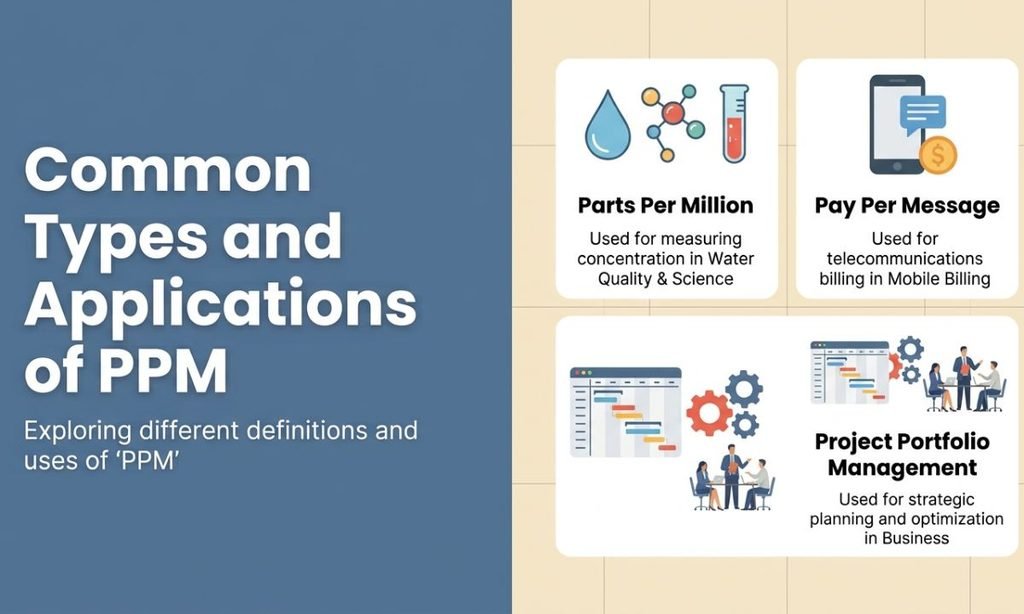
Today, the same three letters can also mean “pages per minute” in printers, or “project portfolio management” in business.
PPM’s Role in Modern Life
Regulators set limits in ppm for drinking water, workplace air, and food additives. Home users meet it too, through water testers, pool strips, and indoor air monitors.
Real-Life Examples of PPM in Conversations

WhatsApp Conversation About Water Quality
Sara: My TDS meter shows 450 ppm. Is that okay? 🤔
Ali: For drinking water, under 500 ppm is generally fine. Taste matters too.
Snapchat Chat About Swimming Pool Chemicals
Zain: Pool test says chlorine is 6 ppm 😬
Hamza: Too high. Most pools aim for roughly 1–3 ppm. Wait before swimming.
Instagram DM About Indoor Air Quality
Mia: My CO₂ monitor says 1,400 ppm in my bedroom.
Noor: That’s stuffy. Open a window. Fresh outdoor air is around 420 ppm.
Text Message About a Laboratory Report
Client: The report lists lead at 0.005 ppm. What does that mean?
Lab rep: It’s five parts per billion, a very small amount. I’ll explain how it compares with the limit.
The Psychological and Practical Significance of PPM
Why PPM Matters in Everyday Life
Tiny numbers can carry big consequences. A few ppm of the wrong substance can change safety, taste, or product quality.
Knowing ppm helps you judge whether a reading is routine or a real warning. It also keeps you from panicking over a number you don’t understand.
What PPM Can Tell Us About Different Perspectives
The same number means different things to different people:
- A homeowner sees water safety.
- A farmer sees nutrient balance.
- A factory manager sees defect rates.
- A regulator sees legal limits.
So always ask: ppm of what, and in what?
How PPM Is Used in Different Contexts
1. PPM on Social Media
Here, ppm usually shows up in science, health, and DIY posts. Think aquarium tips, skincare “active ingredient” talk, and pool care videos. Occasionally it is used as an abbreviation for something else entirely, so context matters.
2. PPM in Everyday Conversations With Friends
Friends mention it when sharing a water test, a hydroponics setup, or an air monitor reading. It is casual and practical, not formal.
3. PPM in Professional and Workplace Settings
At work, the meaning depends on the field:
- Laboratories and environmental teams: concentration of substances
- Manufacturing: defective parts per million
- Project teams: project portfolio management
- Offices: pages per minute for printers
- Electronics: pulse-position modulation, a signal method
4. PPM in Casual and Formal Situations
Casually, people say “it’s about 300 ppm.” In formal reports, they specify the basis, such as mg/L or ppm, and the testing method.
Common Misconceptions About PPM
1. Confusing PPM With Percentage
A percentage is parts per hundred. PPM is parts per million. They are far apart:
- 1% = 10,000 ppm
- 0.1% = 1,000 ppm
2. Assuming Low PPM Levels Are Always Harmless
Small does not always mean safe. Some substances are harmful at very low levels. Carbon monoxide at a few dozen ppm can cause symptoms over time, and lead is regulated in parts per billion.
3. Using PPM in the Wrong Context
Saying “PPM” to a project manager and a chemist gets two different meanings. If it isn’t clear, spell it out: “parts per million” or “project portfolio management.”
PPM Compared With Other Measurements: Key Differences and Examples
| Unit | Meaning | Equivalent | Example |
| % | Parts per hundred | 10,000 ppm | Salt in seawater (about 3.5%) |
| ppm | Parts per million | 1 mg/L (in water) | Chlorine in a pool |
| ppb | Parts per billion | 0.001 ppm | Lead in drinking water |
| ppt | Parts per trillion | 0.000001 ppm | Trace contaminants |
| mg/L | Milligrams per liter | ≈ 1 ppm in water | Lab water reports |
Quick tip: For dilute water solutions, ppm and mg/L are practically interchangeable. For gases, ppm usually refers to volume (ppmv), not weight.
Common Types and Applications of PPM
PPM can be expressed in a few ways, depending on what is being measured:
- ppm by mass (ppmw): grams of substance per million grams of mixture
- ppm by volume (ppmv): common for gases in air
- ppm by mole: used in some chemistry and atmospheric work
| Application | What PPM Measures | Typical Reference |
| Drinking water | Dissolved solids, chlorine, fluoride | TDS under about 500 ppm is a common guideline |
| Swimming pools | Free chlorine | About 1–3 ppm |
| Indoor air | CO₂ levels | Above 1,000 ppm can feel stuffy |
| Outdoor air | CO₂ | Roughly 420 ppm today |
| Quality control | Defective parts | Defects per million units |
| Agriculture | Nutrient concentration | Varies by crop |
How to calculate PPM:
PPM = (mass of substance ÷ mass of total mixture) × 1,000,000
Example: 5 mg of salt dissolved in 2 liters of water ≈ 5 ÷ 2 = 2.5 ppm.
How to Respond When Someone Mentions PPM
Casual Ways to Respond to PPM
- “Oh nice, what’s it measuring?”
- “Is that high or normal?”
- “Which tester did you use?”
Funny Responses to PPM
- “Is that parts per million… or pizza per month? 🍕”
- “That’s a lot of numbers for such a tiny amount!”
- “My brain reads ‘PPM’ as ‘please explain more.’ 😄”
Mature and Confident Responses to PPM
- “What’s the safe range for that substance?”
- “Is that measured by mass or volume?”
- “Can you share the test method or report?”
Private and Respectful Responses to PPM
If the number relates to someone’s health, home, or workplace results, keep it gentle:
- “Thanks for sharing. Do you want help understanding it?”
- “If it’s a safety concern, a certified lab or local authority can confirm it.”
Regional and Cultural Differences in PPM Usage
PPM Usage in Western Cultures
In the US, UK, and Europe, ppm appears in water quality reports, workplace safety rules, and pool care. Many consumer products list ppm values, such as fluoride toothpaste.
PPM Usage in Asian Cultures
TDS meters in ppm are popular for checking drinking water and RO purifier performance. Manufacturing hubs also track defect rates in ppm.
PPM Usage in Middle Eastern Cultures
Desalinated water, greenhouse farming, and oil and gas safety make ppm widely used. Gas monitoring in industrial work is routinely reported in ppm.
PPM in Global Online Communication
Online, the scientific meaning is the most common worldwide. Still, always add context, because “PPM” can also mean pages per minute or project portfolio management.
Conclusion
PPM means parts per million. It is a simple way to describe very small amounts inside a larger mixture, from chlorine in a pool to CO₂ in a bedroom.The same three letters can also mean pages per minute or project portfolio management, so the field you’re in matters.
Remember three things: ppm is not a percentage, small numbers aren’t always safe, and context decides the meaning. Check the “of what, in what” every time, and you’ll read any ppm number with confidence. When a reading looks unusual, compare it with a trusted safety guideline before you act.
Frequently Asked Questions
What Does PPM Mean in Simple Terms?
PPM means “parts per million,” or how many parts of a substance exist in one million parts of a mixture. It is used for very small concentrations.
Is a Higher PPM Level Always Bad?
No. It depends on the substance. A higher CO₂ or lead reading is a concern, while a plant nutrient may need a higher ppm to work well.
Is PPM Used Only in Science?
No. It is also used in manufacturing, farming, and home care. In business and tech, PPM can mean project portfolio management or pages per minute.
What Is Considered a Safe PPM Level?
It depends on the substance. Examples: drinking water TDS under about 500 ppm, pool chlorine around 1–3 ppm, and indoor CO₂ ideally below 1,000 ppm.
How Do You Calculate PPM?
Divide the mass of the substance by the total mass of the mixture, then multiply by 1,000,000. In water, 1 mg per liter equals roughly 1 ppm.
Does PPM Have the Same Meaning Worldwide?
Yes, the scientific meaning is the same everywhere: parts per million. Only the slang and business uses vary by field.
