


“Some of whom” is the correct and standard form when you’re referring back to part of a group of people that was just mentioned. “Some of who” is not considered standard English in this construction, and careful writers avoid it in formal or professional writing.
The short reason comes down to grammar roles: who works as a subject, while whom works as an object, including after a preposition like “of.” Once you see how the preposition changes the pronoun’s job in the sentence, the rule becomes easy to apply without memorizing exceptions.
Is “Some of Whom” Correct?
Yes, “some of whom” is grammatically correct and is the version used in edited, professional English. It typically follows a comma and refers back to part of a group already introduced earlier in the sentence, such as “I met several neighbors, some of whom work from home.”
Is “Some of Who” Ever Correct?
“Some of who” is not standard in this construction, since “of” requires an object pronoun and “who” is a subject pronoun. It can technically appear only inside a larger question structure, such as “Some of who did what, exactly?” though this is rare and mostly conversational rather than written English.
The Simple Rule for Using “Some of Whom”
Use “Whom” When It Refers to Part of a Group
When a phrase points back to a portion of people mentioned earlier, whom is the pronoun that fits, because it’s functioning as the object of the preposition “of,” not as the subject of a new action.
Look for the Preposition “Of”
Any time “of” sits directly before the pronoun, that pronoun needs to be in the object form. This single pattern explains why “whom” appears after “some of,” “many of,” “all of,” and similar phrases.
Think “Some of Them” to Remember the Rule
A quick mental swap works well: if “some of them” sounds natural, then “some of whom” is the correct written form. This trick sidesteps grammar terminology and relies on instinct instead.
Why Is “Some of Whom” Grammatically Correct?
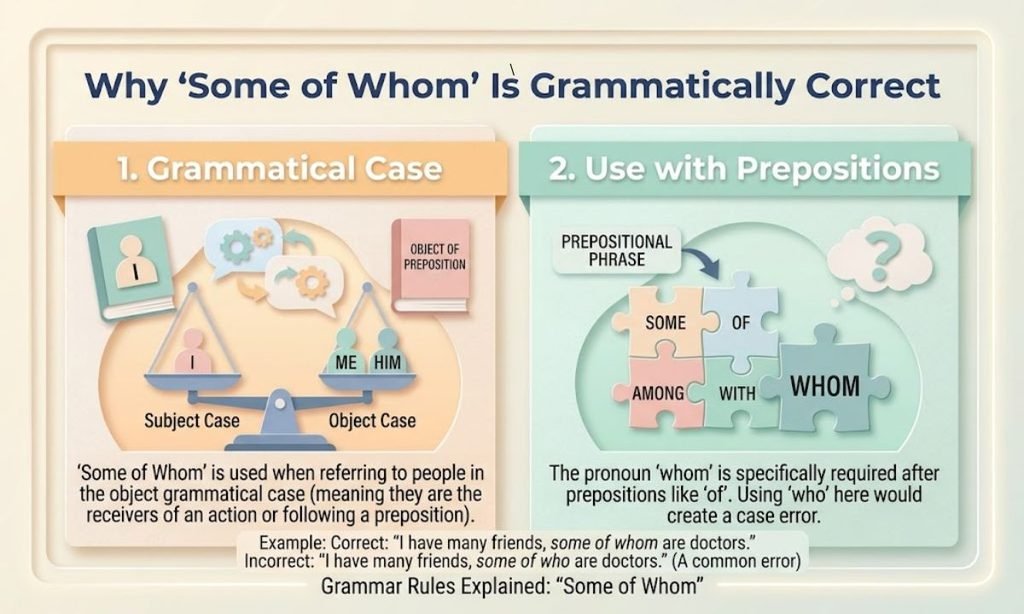
“Whom” as an Object Pronoun
Whom always functions as an object, meaning it receives an action or follows a preposition, rather than performing the action itself.
How the Preposition “Of” Changes the Structure
Prepositions like “of,” “to,” and “with” pull the pronoun that follows them into the object role automatically, which is why “who” cannot sit directly after “of” in standard writing.
How “Some of Whom” Refers Back to People
The phrase connects to a previously named group, adding extra detail about part of that group without restarting the sentence or repeating the noun.
Who vs Whom: What Is the Difference?
When to Use “Who”
Who is used when the pronoun is the subject of a clause, meaning it performs the action described by the verb.
When to Use “Whom”
Whom is used when the pronoun receives the action, or when it follows a preposition such as “of,” “to,” “for,” or “with.”
The He/Him and They/Them Test
A fast way to check: replace the pronoun with he or him, they or them. If “he” or “they” fits, use who. If “him” or “them” fits, use whom.
| Test Pronoun | Replacement | Correct Form |
| He / They | Subject role | Who |
| Him / Them | Object role | Whom |
How to Use “Some of Whom” in a Sentence
“Some of Whom” at the End of a Sentence
Example: “She manages a large team, some of whom have been with the company for over a decade.”
“Some of Whom” After a Comma
The comma signals a nonessential clause, adding extra information rather than restricting the meaning of the group already named.
“Some of Whom” in a Relative Clause
In “We interviewed several candidates, some of whom had previous experience,” the structure breaks down simply: several candidates is the larger group, some of whom points to part of that group, and had previous experience adds new detail about them.
Some of Whom Examples in Everyday English
Examples With Friends and Family
- I have four cousins, some of whom live abroad.
- She invited old classmates, some of whom she hadn’t seen in years.
Examples for School and College Writing
- The professor cited several researchers, some of whom disagreed with her conclusion.
- Our class has thirty students, some of whom study part-time.
Examples for Work and Business Writing
- The company hired ten new employees, some of whom started remotely.
- We surveyed our clients, some of whom requested faster support.
Examples With Groups of People
- The charity supports many families, some of whom lost their homes.
- Local officials met with residents, some of whom raised safety concerns.
Some of Whom vs Some of Who Examples
| Common Version | Standard Revision |
| some of who | some of whom |
| several people, some of who arrived late | several people, some of whom arrived late |
| many students, some of who passed the exam | many students, some of whom passed the exam |
The revision works because each pronoun follows “of,” which forces the object form, whom, rather than the subject form, who.
When Should You Use “Who” Instead of “Whom”?

Use “Who” for the Subject
“Who called you?” is correct because who performs the action of calling.
Use “Whom” for the Object
“Whom did you call?” is correct because the pronoun receives the action of calling.
Easy Examples to Tell Them Apart
- The people who arrived early got the best seats.
- The people whom we invited didn’t all show up.
“Some of Whom” in Formal vs Informal English
Is “Some of Whom” Better for Formal Writing?
Yes, formal writing, academic papers, business reports, and journalism consistently favor “some of whom” over any casual alternative.
What Happens in Everyday Speech?
In relaxed spoken English, many speakers simplify the structure entirely, saying something like “I met a few people, and some of them work from home” instead.
Should You Use “Whom” in an Email?
Professional or formal emails benefit from “whom” in this exact construction, since it signals careful, polished writing without sounding overly stiff.
Common Mistakes With “Some of Whom”
Writing “Some of Who” in the Standard Construction
This is the most frequent error, usually caused by treating whom as old-fashioned and defaulting to who everywhere.
Confusing Who With Whom
Writers sometimes swap the two pronouns simply because whom feels formal, without checking whether the word is acting as a subject or an object.
Forgetting the Comma in a Nonessential Clause
Leaving out the comma before “some of whom” can make the sentence harder to read and blurs the boundary between the main clause and the added detail.
Using “Whom” When “Who” Is the Subject
Overcorrecting is common too, such as writing “whom is responsible” instead of the correct “who is responsible.”
Some of Whom vs Some of Them vs Who
When to Use “Some of Them”
Use this simpler, casual phrase in everyday speech or informal writing when a relative clause isn’t needed.
When to Use “Some of Whom”
Use this in a relative clause that adds detail directly back to a previously named group of people within the same sentence.
When to Use “Who”
Use who whenever the pronoun itself is performing the action as the subject of its own clause.
Can You Say “Some of Whom Were”?
“Some of Whom Were” Examples
“The visitors toured the facility, some of whom were journalists.” Whom does not control the verb; the verb agrees with the people the phrase represents.
“Some of Whom Are” Examples
“He manages several teams, some of whom are based overseas.”
“Some of Whom Have” Examples
“The committee reviewed dozens of applications, some of whom have reapplied before.”
Some of Whom vs Many of Whom vs All of Whom
Some of Whom
Refers to a portion, not the whole, of the previously mentioned group.
Many of Whom
Refers to a large portion of the group, though still not necessarily all of it.
All of Whom
Refers to the entire group without exception.
Several of Whom
Similar to “some of whom,” but usually implies a slightly more specific or countable number.
Few of Whom
Refers to a small portion of the group, often emphasizing scarcity or rarity.
Where Does the Rule for Whom Come From?
English inherited its case system from older Germanic grammar, where nouns and pronouns changed form depending on their role in a sentence. Most of that system faded over time, but pronouns like who and whom kept the subject-object distinction, which is why this one pair still trips up modern writers even though the rest of English mostly abandoned case endings.
Some of Whom in Academic and Legal Writing
Academic papers, legal documents, and formal reports rely on “some of whom” heavily because precision matters in these fields. Legal writing in particular often needs to specify exactly which portion of a group a clause refers to, and “some of whom” keeps that reference unambiguous without restructuring the sentence.
Regional Differences: American vs British Usage
Both American and British English treat “some of whom” as the standard form in formal writing. The difference shows up more in spoken usage, where British speakers slightly more often retain whom in conversation, while American speakers tend to simplify toward “some of them” outside of formal contexts.
Tools and Tricks to Check Who vs Whom Instantly
- Swap the pronoun with he/they (subject) or him/them (object) to test the role.
- Check whether a preposition like “of,” “to,” or “with” comes right before the pronoun.
- Read the sentence aloud and see if it sounds like a question you’d answer with “he” or “him.”
Is Whom Disappearing From Modern English?
Whom has become rarer in casual speech, and many everyday conversations skip it entirely in favor of who or a full rewrite. However, in fixed phrases like “some of whom,” “many of whom,” and “to whom it may concern,” whom remains firmly standard, especially in formal and written English.
Quick “Some of Whom” Grammar Test
Step 1 : Identify the People
Check whether the phrase refers back to a group of people already mentioned earlier in the sentence.
Step 2 : Try “Some of Them”
If “some of them” sounds natural in that spot, “some of whom” will usually fit the formal relative structure too.
Step 3 : Check the Sentence Structure
Confirm the pronoun follows a preposition or functions as an object, not as the subject performing a new action.
Frequently Asked Questions
Is it “some of whom” or “some of who”?
“Some of whom” is the correct and standard form. “Some of who” is not considered proper written English in this construction.
Why is “some of whom” correct?
Because “of” is a preposition, and prepositions require the object pronoun whom rather than the subject pronoun who.
Can I say “some of who”?
Not in standard writing; it’s grammatically inconsistent since “of” always pulls the following pronoun into the object form.
What is the difference between who and whom?
Who is used for subjects performing an action, while whom is used for objects receiving an action or following a preposition.
How do you use “some of whom” in a sentence?
Place it after a comma to add detail about part of a group already mentioned, such as “several guests, some of whom left early.”
Is “some of whom” formal?
Yes, it’s considered formal and polished, making it a strong choice for professional, academic, and business writing.
What does “some of whom” mean?
It means a portion, not all, of a previously mentioned group of people, with more detail following about that portion.
What is the easiest way to remember who vs whom?
Swap in he or they for who, and him or them for whom, whichever sounds natural tells you the correct pronoun.
Is “some of whom were” correct?
Yes, it’s correct, since the verb agrees with the people represented by the phrase, not with the pronoun whom itself.
What is another way to say “some of whom”?
In casual speech, “some of them” is a common and acceptable substitute outside of formal writing.
Conclusion
“Some of whom” is the standard, grammatically correct form when referring back to part of a previously mentioned group of people. Who works as a subject, whom works as an object, and any pronoun sitting directly after a preposition like “of” needs to take the object form, whom, not who.
