


A friend sends a message that says “WTW?” and nothing else.Is it a greeting, a plan, or a question about something you missed? Many people freeze for a second before they reply.
In most chats, WTW means “what’s the word?” It is a casual way to ask what is going on. This guide explains every meaning, with examples, tone tips, and replies you can copy right away.
What Is the Meaning of WTW in Texting? Quick Answer
WTW usually stands for “what’s the word?” It is slang for “what’s up?”, “what’s going on?”, or “what are the plans?”
Someone who sends it wants an update, a plan, or a quick check-in. The exact meaning depends on the words around it, the person who sent it, and the time of day.
| Message | Likely Meaning |
| “WTW?” | What’s up? |
| “WTW tonight?” | What are we doing tonight? |
| “WTW with the party?” | What is happening with the party? |
| “WTW with you?” | What is going on with you? |
| “So WTW?” | So, what’s the plan? |
Some people also read WTW as “what’s the wave,” which carries the same idea. Both versions are casual, friendly, and open-ended.
A simple rule helps here. If a message has a time, place, or event next to WTW, it is about plans. If it stands alone, it is a greeting.
Where WTW Came From: Origin and Background
WTW comes from the spoken phrase “what’s the word?” People used that line long before smartphones to ask for news, gossip, or an update. A friend might ask, “So, what’s the word on the meeting?”
The phrase is often linked to Black American speech. It spread through music, social media, and youth slang, then reached a much wider audience. Texting turned it into a three-letter shortcut.
Short forms save time. Instead of typing “what’s the word,” people send WTW. Over time, the abbreviation reached Snapchat, Instagram, TikTok, and group chats around the world.
A newer version, “what’s the wave,” also appears online. It means about the same thing and sounds a little more relaxed. Today, both versions live side by side, and most people understand either one from context.
Slang like this tends to travel in the same way each time. It starts in speech, moves into songs and videos, and then lands in text. WTW followed that exact path.
Real-Life Conversations: How People Actually Use WTW
Short chats show how the word works in daily life. Each one below uses WTW in a slightly different way.
WhatsApp Chat Example
Danish: WTW for dinner tonight?
Imran: I am free after 8. Want to try the new burger place?
Danish: Sounds good. I will tell the others.
Imran: Perfect. Send me the time.
Here, WTW means “what are the plans?”
Instagram DM Example
Hira: WTW? Haven’t heard from you in ages.
Maha: Life got busy. Work, family, everything.
Hira: Same. We need to catch up soon.
Maha: Definitely. Coffee this weekend?
Here, WTW works like “what’s going on with you?”
Text Message Example
Zain: WTW this weekend?
Ali: Saturday works. Sunday I have family plans.
Zain: Saturday it is. Maybe a movie?
Ali: Sounds good.
Here, the sender clearly wants to make plans.
The Emotional and Psychological Meaning of WTW
WTW feels low-pressure. A long message can sound formal or needy, but “WTW?” is quick and open. It asks without demanding.
It lets the other person decide how much to share. That makes it a safe way to start a chat after a long gap. The reader can answer with one word or a full story.
It can also show interest without a big commitment. A person who is unsure about reaching out may find it easier to send three letters than a full paragraph. That small risk feels easier to take.
The tone depends on the relationship. From a close friend, it feels warm and spontaneous. From someone you have not spoken to in months, it may feel like a test to see if you are open to talking again.
The abbreviation itself is neutral. The relationship, timing, and mood give it feeling. Many people also use it because short messages fit busy lives.
There is also a social benefit. A short, relaxed opener avoids the awkward feeling of a big, serious message. It keeps the door open without forcing a response.
The Other Meanings of WTW, From Genuine Shock to Rare Acronyms
“What’s the word?” is by far the most common meaning. Still, a few others appear in chats and posts.
| Meaning | What It Means | Example |
| What’s the wave | Same as “what’s up” or “what’s the plan” | “WTW tonight?” |
| What the what | Shock or confusion | “WTW?! Did that just happen?” |
| What to wear | Asking for outfit advice | “WTW to the wedding?” |
| What to watch | Asking for a show or movie idea | “WTW on Netflix tonight?” |
| Worth the wait | Something was worth waiting for | “That cake was WTW.” |
| Walk the walk | Backing words with action | “Time to WTW.” |
How do you tell them apart? Look at the topic. Outfit talk points to “what to wear,” a streaming chat points to “what to watch,” and a surprised tone with exclamation marks points to “what the what.”
The rare meanings mostly show up in specific chats. “Worth the wait” appears in reviews and food posts. “Walk the walk” shows up in motivation posts. If none of these fit, assume the main meaning.
When you are not sure, ask. A short question like “Do you mean what’s up?” clears things up fast.
How WTW Is Used in Different Contexts
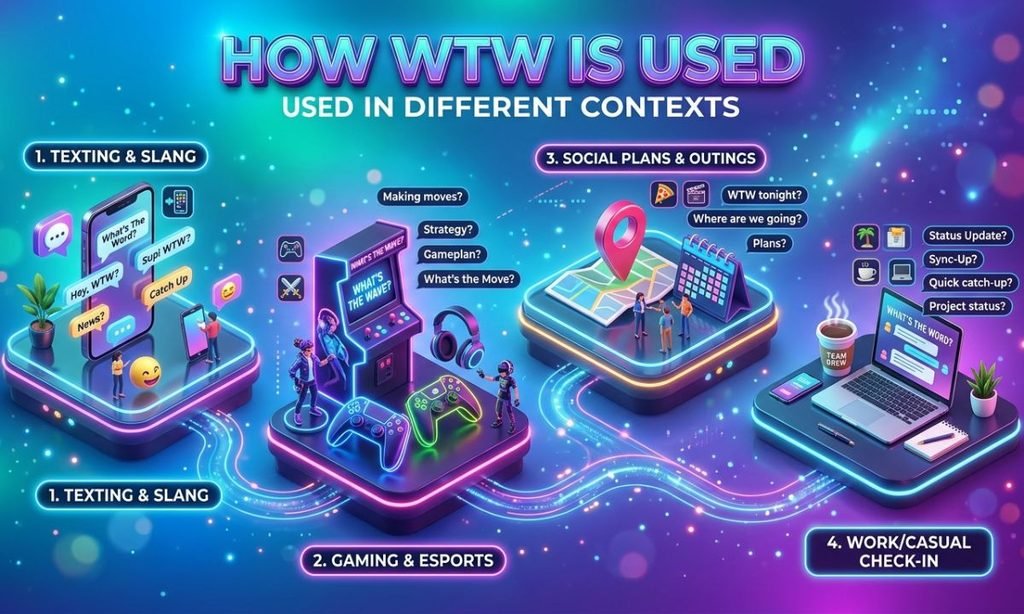
The meaning stays close to “what’s up,” but the purpose changes with the setting.
WTW on Social Media
On Instagram, Snapchat, and TikTok, WTW often appears in DMs and story replies. A friend may reply to your story with “WTW, you outside?” to ask what you are doing.
In comments, it can start a chat or ask about plans. It usually keeps a relaxed tone. Creators also use it in captions to invite replies.
On Snapchat, people sometimes send a selfie with “WTW?” as the caption. It works like a quick hello.
| Platform | Typical Use of WTW |
| Snapchat | Quick hello with a selfie or snap |
| Story replies and DMs | |
| TikTok | Comments and creator chats |
| Group plans and check-ins | |
| Text message | One-on-one plans |
WTW Among Friends
Among friends, it is mostly about plans or checking in. You might see “WTW after class?” or “WTW tonight?”
The tone is familiar and quick. Friends often follow it with a place, a time, or a joke. It also works well in group chats when someone wants everyone to share plans.
WTW in Relationships and Dating
In dating, WTW can be a casual way to show interest. “WTW later?” may mean “Do you want to talk?” or “Do you want to hang out?”
It is not romantic on its own. The mood of the chat decides that. Emojis, timing, and past messages give more clues.
If the chat has been warm and flirty, WTW may be a gentle opener. If the chat has been cold, it may be a simple check-in.
WTW at Work and in Professional Settings
WTW is too informal for most work messages. Sending your manager “WTW with the project?” may sound careless.
Use clear wording instead:
- “Do you have an update on the project?”
- “What is the latest status?”
- “Are there any updates on the meeting?”
Coworkers who are also close friends may use it in private chats. Even then, keep it away from group work channels.
Casual vs Serious Tone
| Situation | Is WTW a Good Fit? | Why | Better Option |
| Relaxed chat with friends | ✅ Yes | WTW is naturally casual | “WTW?” works fine |
| Making plans or checking in | ✅ Yes | It suits light, everyday talk | “WTW tonight?” |
| Someone shares bad news | ❌ No | “WTW?” can sound careless | “I am here. What happened?” |
| Heavy or emotional moments | ❌ No | Plain words show more care | A simple, caring sentence |
| Everyday, low-pressure talk | ✅ Yes | Fits the relaxed tone | Save WTW for these moments |
Common Myths and Misunderstandings About WTW
Many people make small Myths when they read WTW. Here are the most common ones.
Myth 1: WTW has only one fixed meaning. In reality, the message changes with the words around it. “WTW tonight?” asks about plans, while “WTW with the event?” asks for news.
Myth 2: WTW is always flirty. It is usually just friendly. Do not read romance into it without other signals, like emojis or late-night timing.
Myth 3: WTW is the same as WYD. WYD asks what you are doing right now. WTW is broader and can ask about plans, news, or how you are.
Myth 4: Everyone knows WTW. Older relatives, coworkers, and non-native English speakers may not. If clarity matters, write the full question.
Myth 5: WTW is rude. It is not. It is only informal, so tone and setting matter more than the letters.
Myth 6: You must reply right away. WTW is casual, so a short delay is fine. A reply within a few hours is normal for most chats.
WTW vs. Similar Texting Terms
| Term | Meaning | Typical Use | How It Differs From WTW |
| WTW | What’s the word? | Plans, updates, check-ins | Broad and flexible |
| WYD | What are you doing? | Current activity | More specific |
| WSP | What’s up? | Greeting | Simple hello |
| WTM | What’s the move? | Plans | Closely related |
| WYA | Where are you at? | Location | Asks for a place |
| IDK | I don’t know | Uncertainty | Common reply to WTW |
WTW is wider than most of these. It can ask about news, plans, or simply invite a chat.
If you want a plan, WTM or WTW both work. If you want a location, use WYA. If you want a quick hello, WSP is enough. Picking the right one keeps your message clear.
WTW Variations and Related Phrases

1. WTW?
Meaning: What’s the word?
Example: “WTW? Long time no talk.”
This is the simplest form. It works as a hello and an invitation to chat.
2. WTW Tonight?
Meaning: What are the plans tonight?
Example: “WTW tonight? I am free after seven.”
People use it when they want to hang out or meet up.
3. WTW Later?
Meaning: What are you doing later?
Example: “WTW later? We can grab coffee.”
It suggests a loose plan without fixing a time.
4. WTW This Weekend?
Meaning: What are the weekend plans?
Example: “WTW this weekend? Anyone up for a trip?”
Common in group chats where friends plan outings.
5. WTW With You?
Meaning: What is going on with you?
Example: “WTW with you? You seem quiet today.”
A casual check-in that shows care.
6. WTW With That?
Meaning: What is happening with that situation?
Example: “WTW with that job offer?”
Used to ask for an update on something specific.
7. So WTW?
Meaning: So, what are we doing?
Example: “So WTW? Are we going or not?”
Often sent after a plan has stalled.
8. Ayo, WTW?
Meaning: Hey, what’s happening?
Example: “Ayo, WTW? You coming out?”
Adds an energetic, friendly tone.
9. WTW Then?
Meaning: So what happens next?
Example: “Okay, WTW then? I am waiting for your call.”
Used when someone is waiting for a decision.
10. WTW Bro?
Meaning: What’s up, or what are the plans?
Example: “WTW bro? Game night at my place?”
A casual form often used between close friends.
Reading the Hidden Message When a Friend or Crush Sends You WTW
WTW can carry more than its words. Look at who sent it, when, and how.
| Sender | Likely Hidden Message |
| Close friend | “I miss talking to you” or “Let’s make plans” |
| Crush | “I am interested, but I am keeping it light” |
| Old friend | “I want to reconnect” |
| Group member | “What’s the plan for everyone?” |
| Ex | “I am testing whether we can talk” |
Check the signals around it:
- Timing. A late-night WTW may point to boredom or wanting company.
- Emojis. A smile or wink suggests warmth, while no emoji can mean casual.
- Past chats. Recent messages show the mood.
- Follow-up. If they ask a second question, they want to talk.
- Frequency. Someone who sends it often may enjoy your company.
If you like the person, a friendly reply with a question keeps things going. If you are unsure, ask, “WTW with you? Anything specific?”
Do not overthink one message. Watch how the chat flows over a few exchanges before you decide what it means.
It also helps to think about what you want. If you want to meet, reply with a time. If you want to keep things light, reply with a joke. If you are not interested, a polite, short answer is enough.
How to Reply When Someone Sends WTW
Match your reply to the mood and what you think they mean. A good reply answers the question and keeps the chat open.
Casual Replies
- “Not much, you?”
- “Just chilling. What’s up?”
- “Nothing crazy. You got plans?”
- “I am free. WTW with you?”
Funny Replies
- “The word is food. ”
- “My bed and I have serious plans tonight.”
- “The bills are winning, unfortunately.”
- “The word is I need a vacation.”
Mature and Confident Replies
- “I am free later if you want to make plans.”
- “Nothing planned yet. What did you have in mind?”
- “Busy until 7, free after that.”
- “Depends. What are you thinking?”
Private and Respectful Replies
- “Can I message you privately about it?”
- “I would rather talk about that one-on-one.”
- “Everything is okay. I will explain when we talk.”
- “Let’s talk after work, if that is fine.”
If you do not want to chat, a polite reply works too: “I am busy right now, but I will message you later.”
A few tips make replies better:
- Answer the question first.
- Add a question back to keep the chat going.
- Match the length of their message.
- Avoid long replies to a short WTW.
WTW Across Regions and Cultures
WTW means about the same everywhere, but habits differ by region and platform.
Western Culture
In the US and other English-speaking countries, WTW is common in youth slang, texting, and social media. It often appears when people ask about plans. Music and online videos helped spread it.
Asian Culture
In Asian countries, English-speaking users who follow global internet slang may use WTW. Not everyone will recognize it, since local languages and slang are common in daily chats. Younger users on Instagram and Snapchat are more likely to know it.
Middle Eastern Culture
In the Middle East, English-speaking users and people with international friends may use WTW. Its meaning stays the same, though local language is often preferred in daily talk. It appears most in bilingual chats.
Global Internet Usage
TikTok, Instagram, and gaming chats spread WTW quickly. Still, global use does not mean universal understanding. When in doubt, write the full question.
For anyone chatting across borders, this matters. A short explanation, like “WTW means what’s the plan,” avoids confusion and keeps the chat friendly.
Conclusion
WTW usually means “what’s the word?” It is a quick, friendly way to ask what is going on or what the plans are. Other meanings exist, like “what’s the wave” and “what the what,” but context makes them clear.
Read the tone, the timing, and the relationship before you reply. A simple answer with a question back keeps the chat easy. Use WTW when it fits, and write the full words when clarity matters most.
Frequently Asked Questions
What is the meaning of WTW in texting?
WTW usually means “what’s the word?” It is a casual way to ask what is going on. People use it to start a chat, ask for an update, or check on plans.
What does WTW mean when it comes from a girl or a guy?
The meaning is usually the same. Context shows whether it is about plans, a check-in, or interest. Look at the emojis, the timing, and your past chats for extra clues.
Does WTW mean the same as “What’s up”?
They are close. WTW can lean more toward plans and updates. “What’s up?” is usually a simple hello, while WTW often invites a plan or a news share.
How should you reply to WTW?
Answer simply, such as “Not much, you?” Then add your plans or ask what they want to do. A short, friendly reply keeps the chat open and easy.
What does “WTW tonight” mean?
It usually means “what are the plans tonight?” The sender may want to hang out, meet up, or simply chat. A good reply shares your plans or suggests a time.
Is WTW considered rude?
No. It is casual, though too informal for serious or professional talk. The tone depends on the person and the setting, so it is fine between friends.
Is it appropriate to use WTW at work?
Usually not. Use clear, full sentences with managers and clients. Casual slang can look careless in a professional message.
